
When Skin Does Not Retract After Liposuction
Author
Dr. Le Trung Kien
RASA Surgical Practice
"Why skin sometimes fails to redrape after liposuction, and how proper assessment, energy-assisted tightening and surgical planning can reduce that risk."
Expert Analysis by Dr. Lê Trung Kiên
In the consultation room, this question appears almost every day: "Doctor, will the skin sag after liposuction, " At first, I thought this was an overly anxious question. The more I practice, the more I realize this is the most appropriate question a patient can ask. And the honest answer is: yes, if not handled properly.
Liposuction resolves excess fat. However, after the subcutaneous fat layer disappears, the skin above needs time and conditions to contract back to its original position. For young patients, the skin still has good elasticity, and this happens naturally without any further action. However, for the majority of cases, patients over 35 years old, those who have given birth, or those who have recently undergone significant weight loss, the simple mechanism of self-contracture is often insufficient to achieve good aesthetic results.
This is the problem that the aesthetic industry has spent many decades trying to solve. And this is also the reason why J-Plasma, a technology for subcutaneous tissue contraction, has become one of the most discussed topics in recent specialized conferences.
The problem of excess skin: What liposuction alone cannot solve
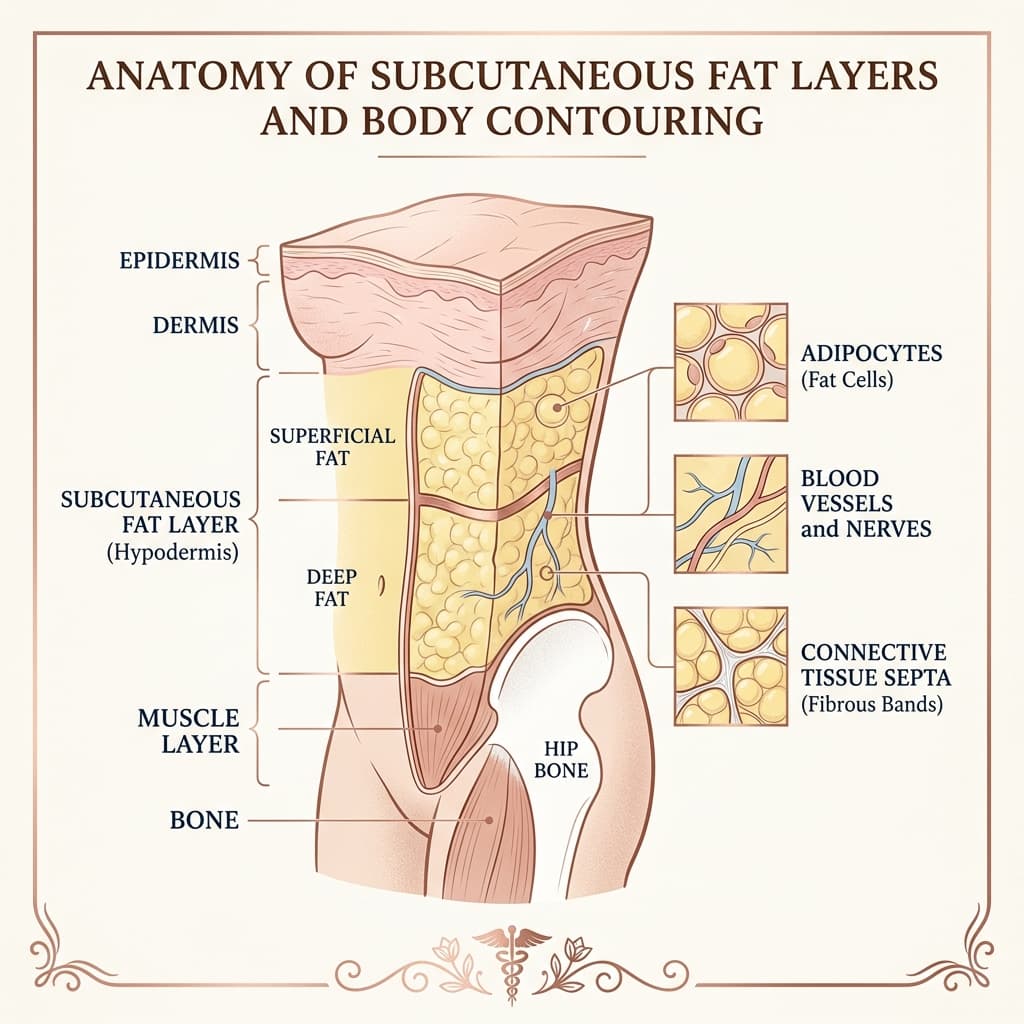
To understand why the skin does not automatically retract after liposuction, one needs to know about the body's skin structure. Beneath the skin layer lies a network of connective tissue called the fibroseptal network (FSN), which is a temporary translation of "skeletal fiber network." This is what creates the "support frame" for the skin, keeping it tightly attached to the body and giving it the firmness that we feel when we touch it.
In my practice, I often explain this by a simpler image: imagine the FSN network as a hammock net. The net is strong, the skin is taut. Over time, the net becomes slack, and so does the skin. Age, childbirth, weight gain and loss: all of these factors stretch the net and gradually reduce its elasticity. Collagen and elastin in the skin also decrease simultaneously. As a result, the skin loses its ability to "snap back" after the volume underneath changes.
Liposuction removes the fat layer, but does not interfere with the FSN network. That's the key point. Therefore, in many cases, the result of liposuction alone can leave the skin loose, with an uneven surface, and even a feeling of "waves" or "pores" under the skin. These are things that no one wants to see after undergoing a surgical procedure.
For many years, the only solution was to remove excess skin: abdominoplasty (tummy tuck), arm lift, thigh lift. Effective, but with long scars, prolonged recovery, and high invasiveness. The gap between "simple liposuction" and "skin removal surgery" is where plasma technology has found its place.
J-Plasma: How it works: The mechanism behind the results
J-Plasma, a brand of Renuvion manufactured by Apyx Medical (USA), is the first and currently the only technology cleared by the FDA for two applications: skin tightening and post-liposuction combination use. Although this may seem like a trivial administrative detail, it is not. When the FDA clears a specific indication, they demand strict clinical data, not just a few case reports or feedback from physicians. This is the scientific foundation that many other aesthetic devices on the market lack.
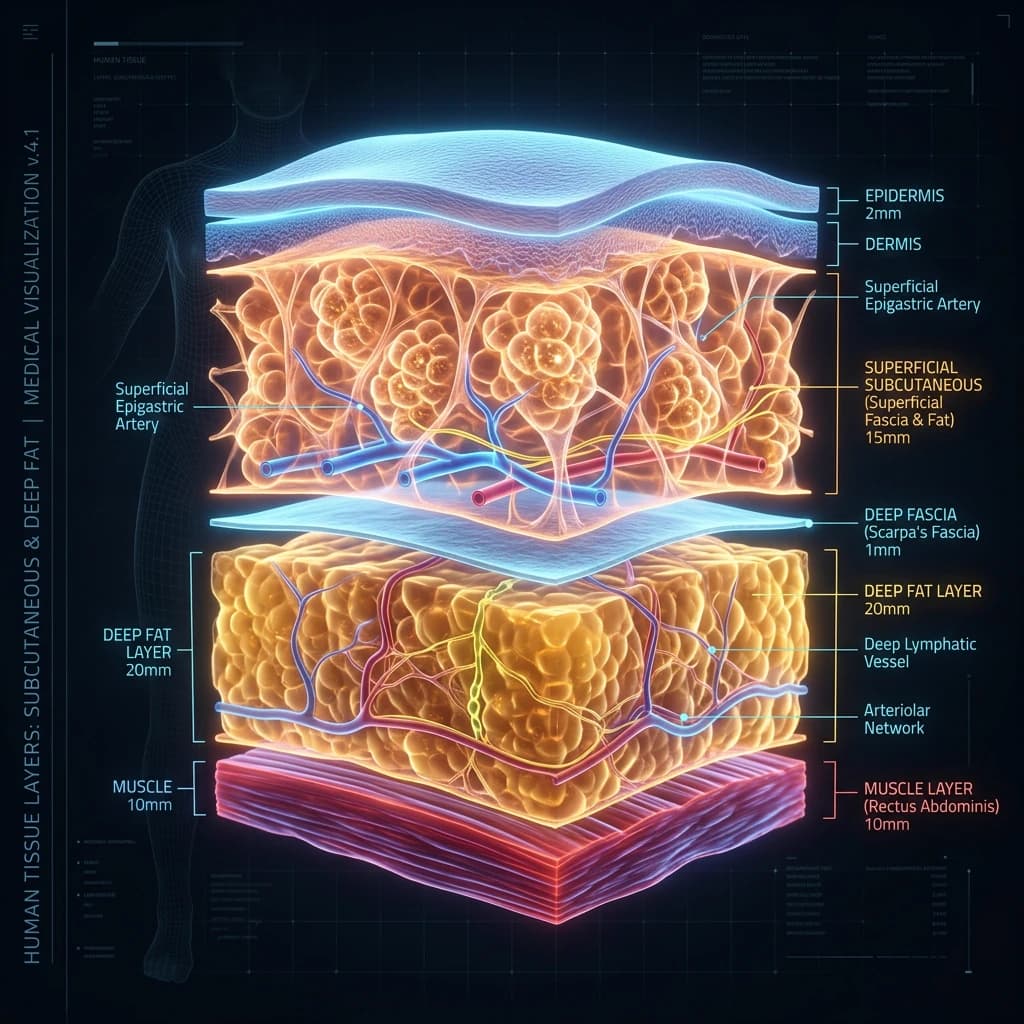
Co hồi mô là câu hỏi trung tâm sau hút mỡ
This technology combines two factors: radiofrequency (RF) energy and helium plasma. When RF energy stimulates helium, it creates a cold plasma flow at the device tip, a fourth state of matter if you remember your physics. This plasma flow is introduced under the skin through a small incision of 2 to 3mm, moving along the treatment area.
What happens next is the key mechanism: plasma comes into contact with subcutaneous tissue, raising the temperature at the site to around 85°C in 0.04 to 0.08 seconds. Not even a tenth of a second. Hot enough for the collagen fibers in the FSN network to contract immediately. Then, the helium gas in the plasma flow rapidly cools the surrounding tissue, preventing heat from spreading and causing unintended damage.
The core difference from conventional RF is there. Conventional RF heats tissue in bulk (bulk heating), which is difficult to control and allows heat to spread. J-Plasma allows the physician to intervene deliberately in specific areas of tissue, with significantly higher accuracy. And because the J-Plasma incision coincides with the liposuction incision, the entire process does not create new scars, a question patients often ask but rarely have clear documentation on.
THE DUAL MECHANISM OF J-PLASMA
• Immediate effects: collagen fibers in the FSN network contract immediately during the procedure, allowing the surgeon and patient to see the skin tighten right away.
• Long-term effects: neocollagenesis is stimulated, resulting in the production of new collagen over the next 3 to 6 months.
• The natural cooling mechanism of helium protects surrounding tissues, minimizing thermal damage outside the treatment area.
Numbers from the study: Not a promise, but data
To be honest, I approach the numbers cited in aesthetic device documentation with caution, as not all data comes from independent studies. With J-Plasma, the research foundation is more transparent, which is why I trust these numbers.
Clinical data show that patients experience a 30 to 50% reduction in skin elasticity immediately after surgery, a change that can be observed directly on the operating table, not a number inferred from images. The process of collagen restructuring continues for 3 to 6 months, with the final results typically evaluated at 6 to 9 months. Some studies have reported a 40% recovery rate after 6 months and a 34% maintenance rate compared to the initial value at 12 months.
A retrospective study of 180 patients, published in The Aesthetic Society's journal through Oxford University Press in 2024, found that 75% of them used J-Plasma in combination with VASER liposuction. More importantly, the study emphasizes that selecting the right patients is the decisive factor. Excessively overweight patients still require traditional surgical excision, and no device can replace that.

Dữ liệu lâm sàng giúp đánh giá nguy cơ da chảy xệ
Regarding the level of trust among medical professionals: Apyx Medical's 2024 survey found that 4 out of 5 doctors agree that J-Plasma/Renuvion is the most trustworthy body contouring technology in the minimally invasive group. To date, more than 325,000 patients worldwide have been treated with this technology since 2017.
""No other technology in the minimally invasive group can achieve this level of skin tightening." - A surgeon with 7 years of experience and over 700 cases treated with Renuvion
Clinical applications: When is it suitable, when is it not,
The most important question with any technology is not "what it can do" but "who it is suitable for." This is where a doctor's clinical expertise truly makes a difference.
J-Plasma yields the best results on patients with mild to moderate sagging skin, those whose skin still has active fibroblast cells and sufficient collagen to react to heat stimulation. Common treatment areas include the abdomen (especially after childbirth or weight loss), arms, inner and outer thighs, sides, back, neck, and jawline.
I have previously declined J-Plasma for some cases where patients were very eager. Not because I wanted to lose the case, but because with the amount of excess skin they had, this technology could not deliver results commensurate with their reasonable expectations. It's always better to be honest upfront than to disappoint patients afterwards. For cases of extensive and very sagging skin, typically after significant weight loss or extensive liposuction, this boundary needs to be evaluated directly, not concluded through images or online consultations.
Regarding procedure time: J-Plasma is usually performed immediately after liposuction in the same session, taking only about 15 minutes per treated area. This combination is beneficial for both efficacy and cost-effectiveness for patients.
SELECTION CRITERIA FOR SUITABLE PATIENTS
• Skin with mild to moderate sagging, still retaining some elasticity
• Stable weight or close to target (significant weight fluctuations after treatment will impact results)
• No smoking, or having stopped for at least 4 to 6 weeks prior to the procedure
• Realistic expectations: noticeable improvement but not equivalent to surgical excision
Procedure and recovery: Reality check
The recovery time is significantly shorter than traditional surgical excision, which is one of the reasons patients are interested in this technology. After the procedure, patients experience swelling and bruising, a completely normal reaction that usually peaks on the third to fourth day. Most can return to light activities within 1 to 3 days and resume normal activities within 1 to 2 weeks.
Wearing a compression garment after treatment is mandatory, not optional. The reason I often explain to patients is: in the early stages after the procedure, the tissue is in the process of reorganization, and the compression garment helps the skin have the "correct shape" to contract back into, rather than forming its own shape under gravity. If removed too early, it's not a disaster, but the final result may be less optimal. Most centers recommend wearing it continuously for the first two weeks, then continuing to wear it during the day for several weeks depending on the situation.

Công nghệ hỗ trợ cần được đặt đúng chỉ định
The most common mistake I see patients make is evaluating the results too soon, at two or three weeks when the tissue is still swollen and new collagen has not yet formed. The actual results are six to nine months later. It's not a "miracle overnight". Clearly communicating this in the consultation helps patients be patient in the right place.
Regarding long-term results: J-Plasma results have been recorded to remain stable for many years, with some clinical documents recording over 8 years, provided the patient's body weight remains stable and they maintain a healthy lifestyle. The fat removed does not regenerate at the site. New collagen is produced, which is the body's own collagen, not a temporary effect.
""A successful cosmetic procedure is not about creating beauty, but about creating the best version of the patient themselves." - Dr. Lê Trung Kiên
The Role of J-Plasma in Modern Aesthetic Technology
The market for fat reduction technology is not limited to J-Plasma. To understand the options, it is necessary to place this technology within the broader context of other methods targeting the same goal.
Radiofrequency-assisted liposuction (RFAL), exemplified by BodyTite, combines liposuction and RF in a single procedure, achieving 30 to 40% fat reduction. Its advantages include a compact integrated system, but it is limited in areas with loose skin and may require multiple treatments. Laser-assisted liposuction, exemplified by SmartLipo, uses laser energy to dissolve fat and stimulate collagen, but the degree of skin tightening is generally lower than J-Plasma in areas with significant skin sagging. Traditional surgical excision remains the definitive solution for significant excess skin, but it involves long scars, general anesthesia, and a 2- to 4-week recovery period.
The key difference of J-Plasma lies in its mechanism: direct action on the FSN network beneath the skin via a cold plasma flow, allowing for targeted heating followed by immediate cooling in a single maneuver. This is why doctors often describe J-Plasma as the "gap filler" between simple liposuction and surgical excision, providing an accurate option for patients who previously had no suitable minimally invasive alternatives.
QUICK COMPARISON OF FAT REDUCTION TECHNOLOGIES
• J-Plasma (Renuvion): plasma helium + RF, FDA cleared after liposuction, direct FSN effect, immediate contraction of 30 to 50%
• BodyTite (RFAL): RF inside and outside the skin, contraction of 30 to 40%, used in combination with liposuction procedures
• SmartLipo: laser heat, melts fat and stimulates collagen, suitable for loose skin
• Surgical excision: maximum effectiveness for excessive skin, long scars, recovery time of 2 to 4 weeks
Physician factor: Good technology requires proper use
No technology operates autonomously. This is a point that most promotional articles on devices tend to overlook, yet it is the factor that truly makes a difference in clinical outcomes.
With J-Plasma, the technique of moving the device head, energy density, processing speed per area, and the doctor's experience in evaluating the patient's skin condition before the procedure all directly impact the outcome and complication rate. A retrospective study of 180 patients mentioned earlier reported a total complication rate of 13.3%, with most being self-resolving edema. The author emphasizes that patient selection and doctor technique are the two most important factors in controlling this number.
To put it bluntly: with the same device and technology, results can be vastly different depending on the practitioner. I say this not to discourage, but to explain why it's essential to research a doctor's experience and training rather than seeking the cheapest or most advertised option.
""Doctors do not create beauty. Doctors only liberate the beauty that already exists in each patient, but they must possess sufficient knowledge to know which tools are suitable for each individual." - Dr. Lê Trung Kiên
Conclusion: A simple question to start with
Is skin elasticity lost after liposuction, This question has no universal answer. It depends on the current elasticity of the skin, age, body history, and most importantly, the technology and intervention technique used.
J-Plasma is a clinically tested tool with a clear scientific basis and is being applied at reputable plastic surgery centers worldwide. It is not a solution for every case, and no ethical doctor would claim that. However, for the right patient population, performed by the right doctor, it fills an important gap that previously had no good solution.
If you are considering liposuction and are concerned about skin issues after surgery, this is exactly what you should discuss during your first consultation. Not after you've made a decision. Not after you've undergone the procedure.
Dr. CKII Lê Trung Kiên
Experienced plastic surgeon with many years of clinical experience, applying advanced techniques in shaping and optimizing the body. Dr. Kiên's professional articles aim to provide accurate medical information, helping patients make informed decisions based on real knowledge rather than advertising.