Lecture note
A focused teaching episode on midface ageing, anatomical spaces, retaining ligaments, lifting vectors and cheek soft-tissue support in facial rejuvenation.
1. Why this topic is worth teaching
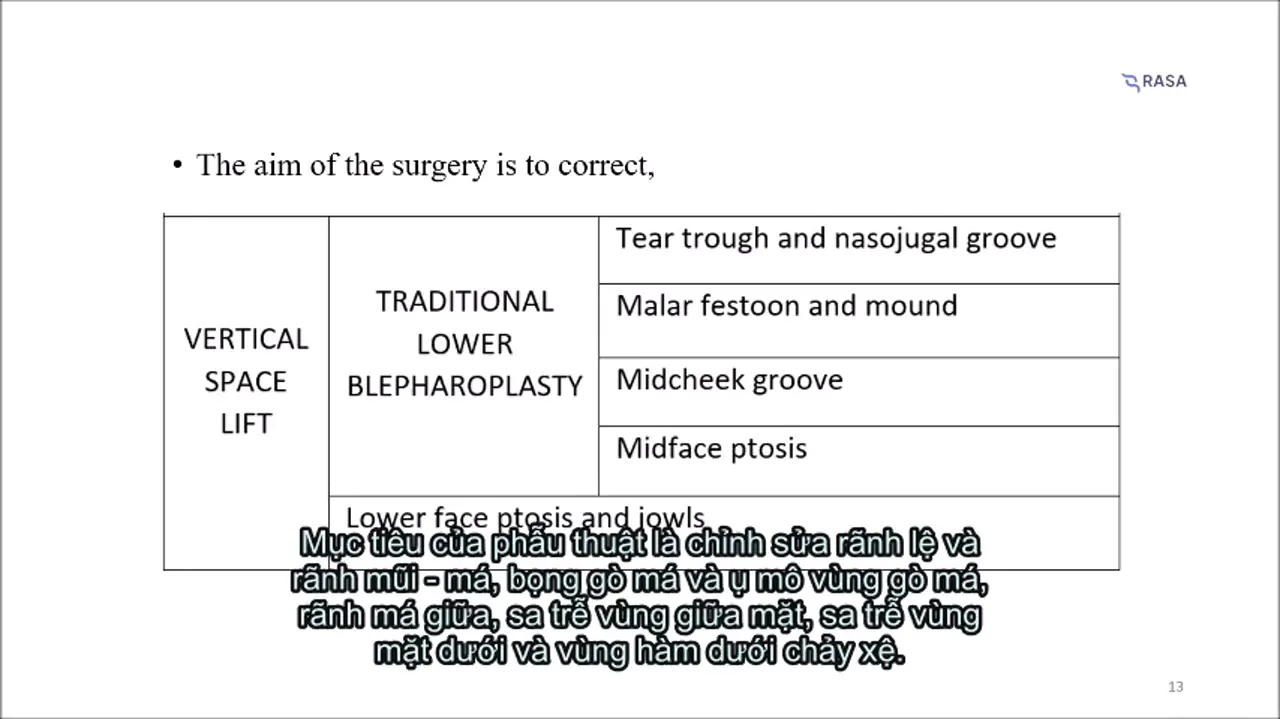
In facial rejuvenation, the lower eyelid, tear trough, cheek, nasolabial fold and jowl are often discussed as separate problems. That language is useful during examination, but it can hide the larger point: these findings belong to a connected soft-tissue support system.
Hadi Nural, MD presents the lower eyelid approach not merely as a skin and fat operation, but as an access route for midface and lower-face support. The educational value is learning to think through spaces, retaining structures and vectors rather than copying a technique mechanically.
2. Anatomy: spaces and connected support zones
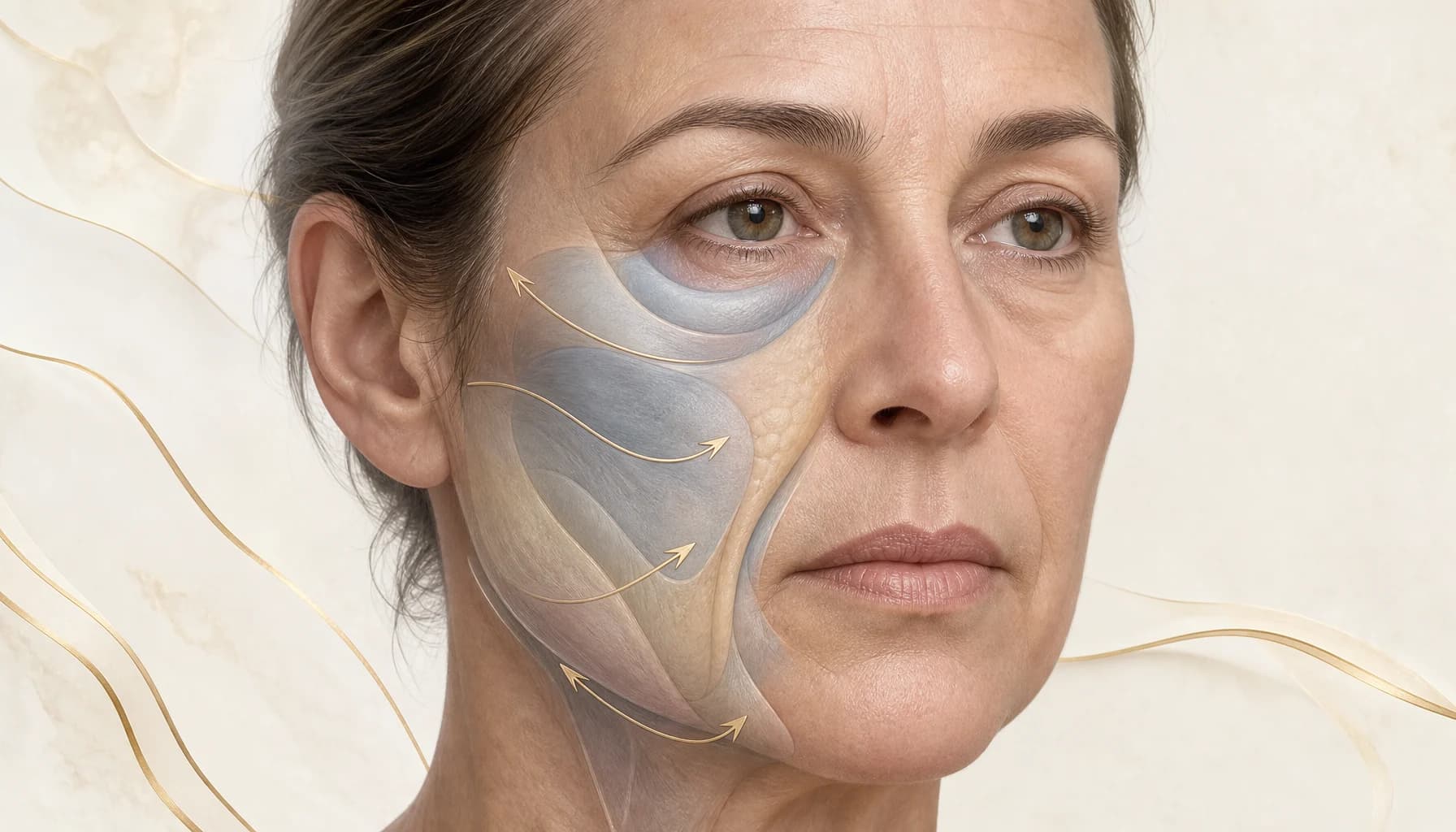
The word “space” matters as much as “lift”. The ageing midface is shaped by tissue planes, fascial boundaries, retaining ligaments and deeper support points that limit how tissue can move.
When soft tissue descends, it is also held by fixed boundaries. This interaction contributes to the tear trough, midcheek groove, nasolabial fold and jowl. The lower eyelid therefore cannot be evaluated separately from the cheek and lower face.
3. Technique: access, release and lifting vectors
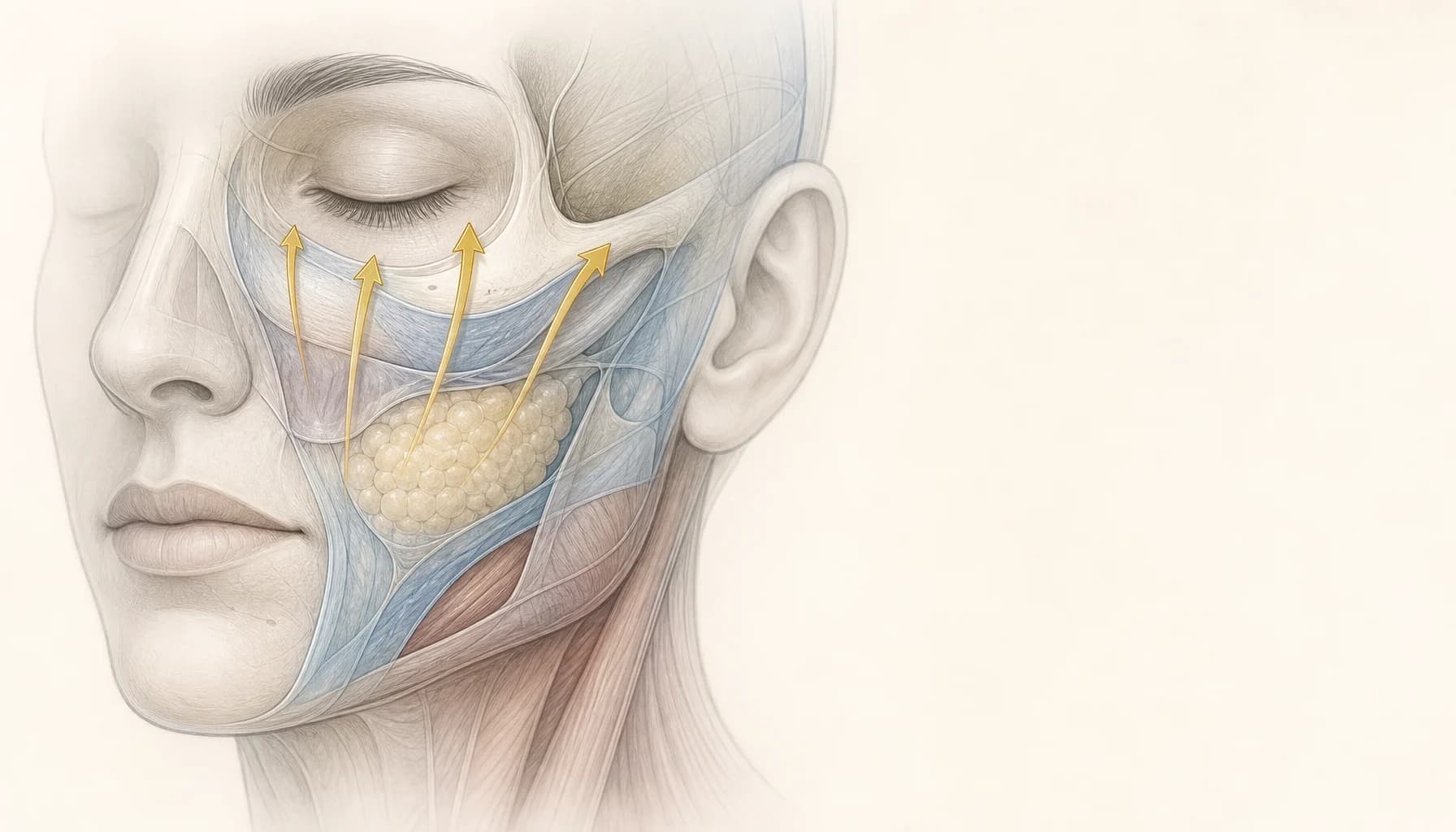
The described operation combines transcutaneous lower blepharoplasty, subperiosteal midface lift and buccal fat pad suspension to the medial infraorbital rim. It also discusses support of lower-face soft tissue through fixation related to the masseteric fascia.
The key is not to memorize the steps as a checklist, but to understand the logic: access, release, repositioning and vector control. Tissue is not simply tightened; it is moved toward anatomically meaningful support.
- The superomedial vector supports the central cheek and lower eyelid-cheek transition.
- The superolateral vector helps the lateral midface and malar contour.
- Buccal fat support is notable because jowling involves deeper soft-tissue descent, not only skin laxity.
4. Indication: who may benefit and who needs caution
The article discusses patients with tear trough depression, midcheek groove, midface ptosis, deep nasolabial folds and jowls. These findings often travel together when midface support has weakened.
A patient with a tear trough or jowl is not automatically a candidate. Lower lid laxity, orbital rim anatomy, globe position, skin quality, soft-tissue thickness, previous procedures and patient expectations all matter.
5. Evidence: reading the paper with the right weight
The article appeared in Aesthetic Surgery Journal Open Forum, Volume 4, 2022, and was published online on 15 December 2021. The abstract reports 23 patients, while detailed analyses refer to smaller subsets depending on available follow-up and photographic data.
The paper is classified as Level of Evidence 4. It is useful for clinical observation, technique description and concept development, but it does not carry the weight of a controlled comparative study.
6. From article to RASA clinical thinking
The central lesson is how to ask better questions. Which tissues have descended? Which retaining structures are restricting them? Which spaces have changed? Which vector can restore support without sacrificing natural expression?
RASA Surgical Education exists to translate medical literature into disciplined clinical thinking. It is not a prompt for patients to choose their own operation. It is a way to show why serious surgical consultation begins with anatomy, indication and safety.
Source material and usage limits
Nural H. Vertical Space Lift: Transcutaneous Lower Blepharoplasty, Subperiosteal Midface Lift, and Lower Face Lift: A Novel Technique of Buccal Fat Suspension to Medial Infraorbital Rim. Aesthetic Surgery Journal Open Forum. Volume 4, 2022, ojab038. Published online 15 December 2021. DOI: 10.1093/asjof/ojab038.
This RASA Surgical Education episode is an educational interpretation with full citation to the original article. It does not replace direct medical consultation, diagnosis or surgical indication.