Lecture note
A practical note from the awake surgery footage in the Tissue Preservation Preceptorship: Preservé is not about making breast augmentation simple, but about patient selection, reduced tissue trauma and a controlled surgical workflow.
1. From tissue-preservation theory to operating room practice
Episode 05 framed Preservé as a tissue-preservation concept rather than a short-incision message. Episode 06 follows the same Tissue Preservation Preceptorship at Victoriakliniken into a live operating room setting, where anatomy, patient selection and pocket limits have to become practical decisions.
The educational value is not a single spectacular manoeuvre. The footage shows a workflow: local anesthesia, communication with the awake patient, controlled instrument direction, bounded pocket creation and funnel-assisted implant placement. A low-trauma technique only works when the whole team operates within the same safety discipline.
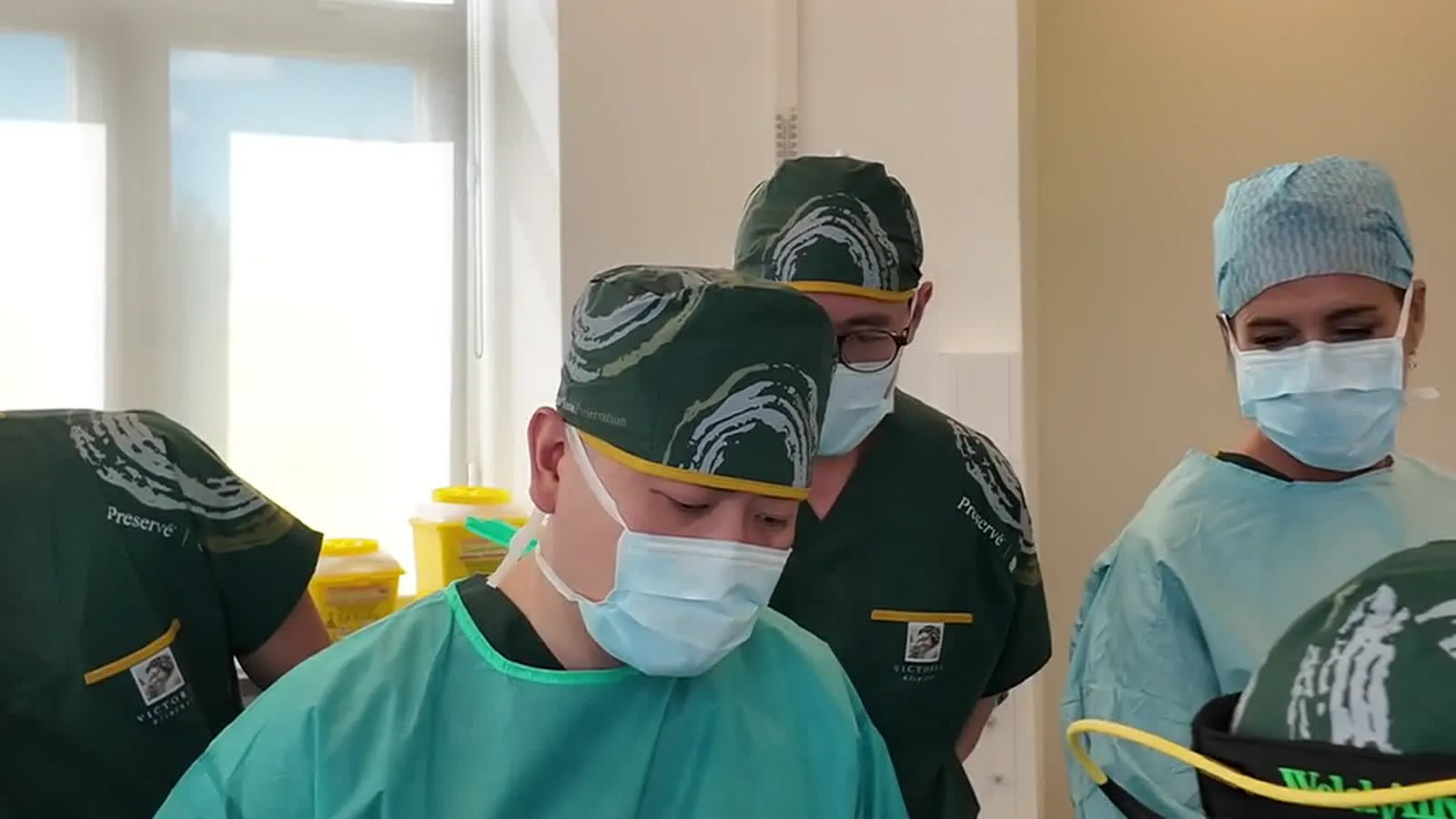
2. Local anesthesia and the awake patient: an operating standard, not a slogan
In the surgical footage, the patient is under local anesthesia and remains able to communicate with the team. This should not be read as a shortcut or as a promise that breast augmentation becomes simple for every patient.
The clinical meaning is more specific. If the patient can remain comfortable during surgery, the team must be controlling pain, operative time, tissue trauma and physiological response in real time. The anesthetic support is active throughout the case, with communication and reassurance maintained at the patient side.
3. Surgical plane: avoiding the gland and preserving the intended pocket
One short clip carries a key teaching point: the faculty warns against creating an intraglandular pocket. If the dissection enters the glandular tissue, the preservation concept is undermined and the implant is no longer being positioned in the intended anatomical relationship.
In Preservé, pocket control is read in relation to the posterior lamina, the pectoralis major fascia and the glandular tissue above. The surgeon must control the direction of the instrument, tissue feedback and the boundaries of the pocket rather than relying on the device alone.
- Do not create a pocket inside the gland when the aim is tissue preservation.
- Do not overexpand beyond the planned breast width and tissue quality.
- Do not let the instrument replace surgical anatomical judgement.
4. Balloon and funnel: controlling trauma step by step
The balloon is not simply a tool for speed. Its role is to expand the pocket with controlled force, reducing the need for wide sharp dissection. The surgeon still has to control entry axis, inflation volume, symmetry and pocket boundaries.
Once the pocket is ready, the implant is inserted with a funnel. The footage shows that this step is also controlled: air management, implant direction, rotation, final seating in the pocket and tissue response all matter. These small steps influence early implant stability and reduce unnecessary tissue handling.
5. Why this is not a technique for every augmentation case
The live case reinforces a point from Episode 05: Preservé is a selected indication. Better candidates are typically primary augmentation patients with adequate tissue coverage, good skin quality, proportionate volume goals and a natural width boundary that matches the chosen implant.
Patients with very thin coverage, marked ptosis, scarred tissue, revision complexity, excessive volume goals or a need to reshape the breast footprint may require another strategy. Using Preservé outside its proper indication can compromise the very tissue-preservation benefit it is meant to protect.
6. Practical lesson for RASA Surgical Education
The lesson is not that awake surgery is always preferable to general anesthesia. A more useful reading is that, with the right indication, reliable local anesthesia and low-trauma handling, the surgical experience can be meaningfully different for selected patients.
For RASA Surgical Education, this footage is professional education material. It illustrates preservation thinking in a real operating room, but it does not replace clinical assessment, implant selection or individualized surgical planning.
Source material and usage limits
This article is based on practical surgical footage from Modern Approaches to Tissue Preservation in Breast Surgery, part of the Tissue Preservation Preceptorship at Victoriakliniken, Stockholm, 25-26 May 2026. It belongs to the same series as Episode 05 on Motiva Preservé foundations and tissue preservation.
It is a RASA Surgical Practice academic interpretation based on the event agenda, edited video material and RASA professional notes. It does not replace individualized medical consultation or surgical indication, and it should not be read as a universal outcome promise.