
Lecture note
Episode 09 summarizes eight teaching modules on facial botulinum toxin, emphasizing muscle-pattern assessment, pharmacologic differences between products and systematic complication prevention.
1. Why RASA brings this faculty training into Surgical Education
Many online materials on botulinum toxin stop at a formula: injection point, number of points and units per point. That format is easy to remember, but it can make toxin injection appear safer and more standardized than it truly is.
Dr. Lam training material was designed for a global faculty setting, where participants are doctors who may later teach other doctors. The content therefore moves beyond injection maps into molecular structure, patient-specific muscle patterns, complication mechanisms and management logic.
The eight modules are best read in three groups: molecular pharmacology, pre-injection assessment through muscle patterns, and systematic recognition and management of complications.

Subtitled excerpt videos
RASA publishes selected short edited excerpts to illustrate the learning structure, not the full training programme. Viewers can choose Vietnamese or English subtitles directly in the video player.
Professional note: the video and article are edited for RASA academic knowledge sharing. The material is intended for professional reference only and does not replace direct consultation, individualized medical indication or hands-on surgical training.
Discuss professional education material with RASA2. Botulinum toxin products are not biologically interchangeable
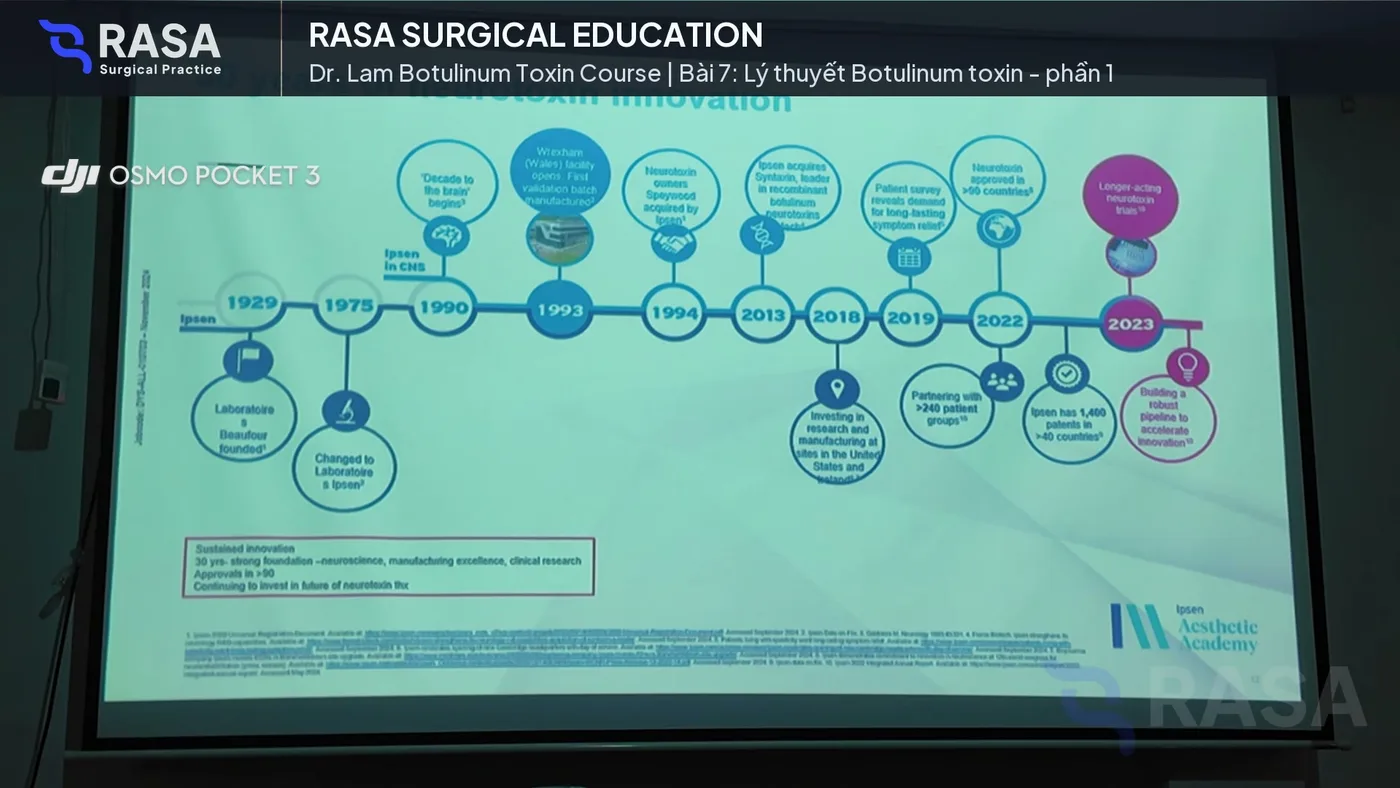
A common mistake is to treat different botulinum toxin type A products as equivalent versions with different commercial names. The lecture clarifies why this is pharmacologically inaccurate.
Products may share a 150 kDa active neurotoxin core, but they differ in complexing proteins, manufacturing process and manufacturer-specific biological potency units. Units from one product cannot be mechanically converted into units of another.
The lecture also separates spread, which is influenced by injection technique, dilution, injection speed and needle size, from passive diffusion along a concentration gradient. This distinction helps clinicians understand what can and cannot be controlled by technique.
3. Assessment starts with muscle patterns, not wrinkle counting
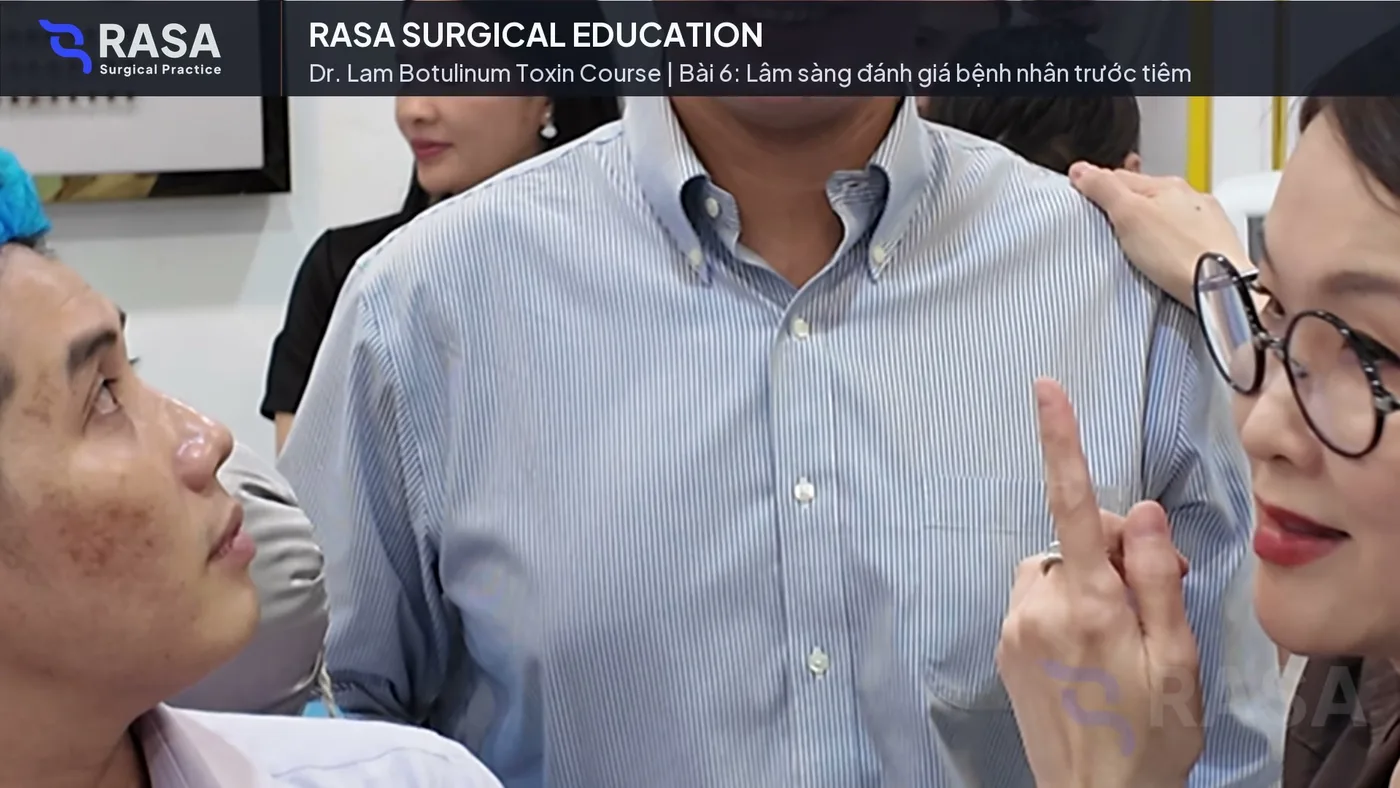
A large part of the course is dedicated to a skill that short injection courses often underemphasize: reading facial muscle activity before placing the needle. Patients must be observed at rest and during active movement to understand which muscles dominate and whether both sides behave symmetrically.
The frontalis is a key example. Its insertion into the brow skin is not identical across patients and may vary between the left and right side of the same face. A fixed injection map can therefore create brow asymmetry or unnatural expression changes.
Pre-injection marking is treated as a required step. It forces an anatomical decision before injection begins.
4. Forehead and periocular zones: small errors become functional complications
The periocular region receives dedicated attention because it is one of the highest-risk zones for facial toxin complications. The orbicularis oculi must be read by functional subregions, including the palpebral component for blinking and corneal protection and the orbital component related to crow feet.
The medial canthal tendon insertion is repeatedly emphasized as a risk landmark. Injection too close to this region may increase the risk of toxin effect near the levator palpebrae superioris.
Some patients have minimal central frontalis activity while the lateral fibers remain strong. Injecting an area without active muscle wastes product and fails to address the true dynamic pattern.
- Periocular treatment must preserve blinking, ocular protection and natural expression.
- Forehead treatment cannot be separated from brow position, eyelid skin excess and baseline ptosis.
- Wrong depth or wrong placement around the orbit can turn a small aesthetic procedure into a functional problem.
5. Complication control begins before injection
The complication module focuses on quizzical brow, Mephisto sign, eyelid ptosis, pseudoptosis and malar edema related to lower eyelid orbicularis pump function.
Each complication is approached through a consistent structure: anatomical mechanism, patient-level risk factors, prevention through injection technique and management once the complication has occurred.
A key message is that many complications are not explained by the product alone. They are strongly connected to depth, placement, dose and whether the injector assessed muscle patterns before treatment.

6. From lecture to clinic: limits and application
This material comes from an international faculty training programme. It is not a self-practice protocol. Specific dose, dilution and point-selection details belong to supervised training, clinician experience and country-specific indications.
RASA preserves the clinical thinking rather than a formula: read muscle patterns before deciding injection points, understand molecular pharmacology before discussing dose and treat complication prevention as part of the treatment plan.
Source material: Dr. Lam, Facial Botulinum Toxin Application, eight training modules from a Global Faculty Education Program. This RASA Surgical Practice article is educational and does not replace direct examination, diagnosis or individualized medical indication.