
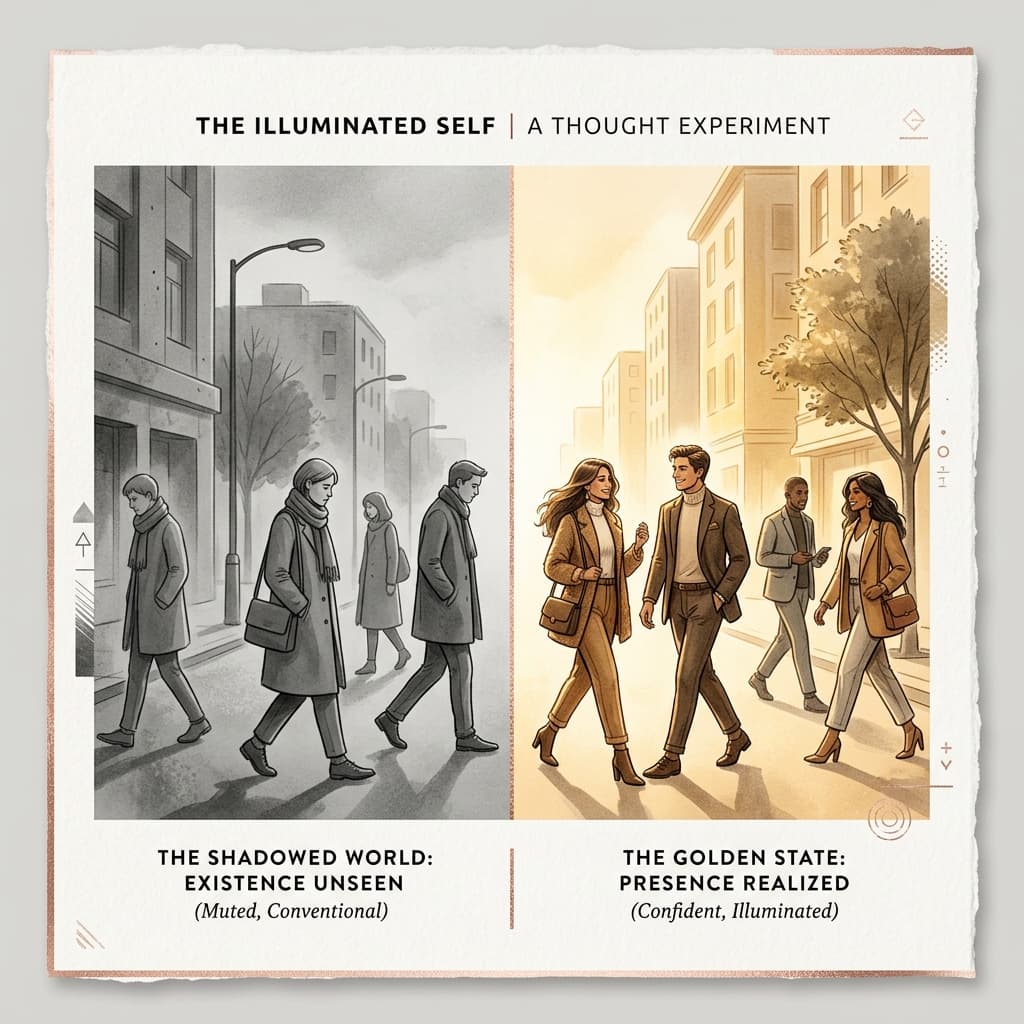
What If Aesthetic Surgery Were Completely Banned?
Author
Dr. Le Trung Kien
RASA Surgical Practice
"A thought experiment on autonomy, body image and the real social role of aesthetic surgery beyond luxury or vanity."
This is a question I have encountered many times, in various ways. From patients who pose it as a challenge: "If there were no aesthetic surgery, what then, Would society be better off, " From critics of the profession: "Aesthetic surgery creates pressure to conform to physical appearance. Ban it and the problem is solved." From myself, in moments of reflection on the role I am playing.
The question may seem progressive, but in reality, it contains a very dangerous assumption: that a world without aesthetic surgery is a more equitable one in terms of physical appearance.
I will argue the opposite.
Thought experiment:
Suppose from tomorrow onwards, all non-medical aesthetic surgery is banned globally.
No nose lifts. No eye surgeries. No liposuction. No filler injections.
Only what nature has given remains.
What actually happens to society,
First: Understand what you want to ban
To think about a world without plastic surgery, one must understand what it does in the current world.
The previous article in this series thoroughly examined the following points: beauty bias is real, the halo effect is real, and beauty premium is measured in real money. People who are more attractive are more easily hired, promoted faster, earn more, and are trusted sooner in business. Not because society is inherently bad. Because the human brain operates according to an evolutionary mechanism that cannot be turned off by willpower.
In this context, cosmetic surgery performs a very specific function: it allows humans to intervene in a characteristic that is entirely determined by genetics and luck. You don't get to choose the face you were born with. But in the current world, you can, to a certain extent, change it.
Banning cosmetic surgery does not ban beauty bias. It only bans one of the few tools humans have to respond to beauty bias.
Scenario 1: Beauty hierarchy returns to its pure genetic state
In a world without cosmetic surgery, human appearance depends entirely on: genetic inheritance from parents, nutritional and environmental conditions from childhood, and natural aging processes that are not intervened with.
It may seem fairer, as no one is entitled to 'buy' an advantage. But in reality, it's the opposite. This is a point where modern social science has a very clear answer.

Một thí nghiệm tư duy về thế giới không có phẫu thuật thẩm mỹ
A study published in the PNAS journal in early 2025 by Hamermesh and Zhang, using three independent datasets from the US and China, confirms: physical appearance has a significant genetic component. Parents who are more attractive have more attractive children. Children who are more attractive earn higher incomes when they grow up. This cycle repeats itself over many generations.
In a world without beauty standards, the beauty hierarchy does not disappear. It becomes purely genetic, locked in even tighter, and less likely to change than any other social class system that history has created.
Think about that for a moment. Social class can at least rise through education, effort, and connections. Income inequality can at least be intervened through tax policies. But genetic inequality in physical appearance, without any intervention mechanism, has no tool for adjustment.
Genetics
Physical appearance has a clear genetic component
PNAS 2025, Hamermesh & Zhang
Three generations
Beauty premium benefits are passed down
from parental income to children's prospects
Forever
Inherited inequality has no cure
without any intervention
""If you ban cosmetic surgery, you won't eliminate physical inequality. You'll only freeze it genetically and prevent anyone from escaping."
Scenario 2: Lookism becomes even more intense, not less
There is an implicit assumption in the argument for banning cosmetic surgery: if no one intervenes in appearance, pressure to conform to a certain appearance will decrease. People will accept each other more.
History does not support this assumption.
Modern cosmetic surgery only emerged in the 20th century and became widespread after the 1960s. Was there less pressure to conform to beauty standards before then, Not at all. The stigmatization of those who did not meet the beauty standards of the time was even more brutal and inhumane due to the lack of language to discuss it.
A more extreme example from American history: towards the end of the 19th century and the beginning of the 20th century, many cities in the US had "ugly laws", laws that actually prohibited people with "unattractive" appearances from appearing in public because the community found them uncomfortable to look at. San Francisco, Chicago, and Portland all had such regulations. They existed until the 1970s in some places.
There was no cosmetic surgery during that time. And the stigmatization of appearance was extremely systematic.
When there is no intervention mechanism, individuals who do not meet societal standards of beauty are not "forgiven," they simply lack the tools to respond. The pressure remains. The consequences remain. But the choice does not.
UGLY LAWS: WHEN SOCIETY HAS NO BEAUTY, IT HAS NO UGLINESS
• Late 19th century: many American cities enacted "ugly laws," prohibiting individuals with "unconventional" appearances from appearing in public

Cấm can thiệp không làm áp lực ngoại hình biến mất
• Chicago, San Francisco, and Portland all had versions of these regulations
• Some laws remained in effect until the 1970s, before being repealed
• This is a stage where cosmetic surgery almost does not exist on a large scale.
Scenario 3: Appearance Inequality Intersects with Economic Inequality
This is the least discussed aspect, but to me, it is the most important from a sociological perspective.
In the current world, cosmetic surgery is a commodity with a price. This means that those who have money have easier access to it. This is a real inequality, and those who criticize the industry are not wrong to point this out.
However, concluding that 'so let's ban it' overlooks an even more important question: if there is no cosmetic surgery, who suffers the most,
The wealthy still have ways to improve their physical appearance: better nutrition from an early age, a healthier environment, less stress, adequate sleep, access to dermatologists, dentists, and hair specialists. Research shows that socioeconomic conditions clearly affect how attractive people are perceived, even before considering cosmetic interventions.
The poor lose their only chance to directly intervene in this factor.
Brazil is a thought-provoking example. In a context where physical appearance plays a significant role in employment and career opportunities, the Brazilian government once subsidized cosmetic surgery at public hospitals for low-income individuals, arguing that this was a form of social equality intervention because without it, the poor would not be able to access the advantages that the wealthy already have. This argument can be criticized from multiple angles, but it shows that the question of cosmetic surgery and equality is not as simple as a straightforward "ban it" approach.
""In a world without cosmetic surgery, the wealthy still have ways to improve their physical appearance that the poor do not. It's just that those ways are not called cosmetic."
Scenario 4: Regenerative medicine will not stop
This is the scenario that proponents of a complete ban on cosmetic surgery often fail to consider.
Modern cosmetic surgery is not separate from regenerative medicine and functional rehabilitation. The techniques used to lift the eyelids are the same techniques used to treat age-related vision loss. The techniques for facial reconstruction are the same techniques used to help patients with head and neck cancer eat and speak normally. Liposuction techniques are also used to treat lymphedema.
The boundary between "cosmetic" and "medical" is not a straight line. And any ban will have to face the question with no clear answer: is eyelid surgery for age-related vision loss medical or cosmetic, Is breast reconstruction after cancer medical, but if the patient wants to choose a larger size than the original, will that part be banned,
I am not raising this question to avoid argumentation. I raise it because it shows that the so-called "ban on cosmetic surgery" in reality cannot exist as a clear policy and be enforced, let alone whether it is effective.
THE MEDICAL AND AESTHETIC BOUNDARY: HARDER TO DRAW THAN IT SEEMS
• Blepharoplasty: Is it cosmetic or a treatment for ptosis affecting vision,
• Breast reconstruction: Medical after cancer, but what size is "medical" and what size is "cosmetic",

Công bằng ngoại hình cần nhiều hơn một lệnh cấm
• Liposuction: Cosmetic, but also used to treat lymphedema and lipedema
• Orthognathic surgery: Cosmetic or treatment for malocclusion affecting mastication function,
• Filler injections: Cosmetic, but also used in post-traumatic and post-injury reconstruction
The Real Problem Is Not Aesthetic Surgery
After all the scenarios above, the question I truly want to ask is: why do we want to ban cosmetic surgery,
The most common answer is: because it creates pressure on physical appearance, because it makes people dissatisfied with themselves, because it promotes unrealistic beauty standards.
However, cosmetic surgery does not create pressure on physical appearance. As seen in the previous article, that pressure originates from the human brain's evolutionary mechanism, dating back tens of thousands of years before any clinic existed. Cosmetic surgery only emerged to meet existing demands.
Unrealistic beauty standards come from social media, from filters, from AI-edited images, and from the entire consumer culture that views physical appearance as a product to be sold. Banning cosmetic surgery without addressing those issues is like banning cars when it rains instead of fixing the drainage system.
The real issue is that society rewards physical appearance in unfair and unconscious ways. That is something that needs to be addressed, through education, changes in hiring procedures, and anti-lookism laws that some US states are experimenting with. Not by taking away the tools people use to cope with that pressure.
""Banning cosmetic surgery does not address beauty bias. It only deprives those who already have few choices of one more choice."
So, what responsibilities does the beauty industry have,
This is the part where, as a professional, I need to speak up.
Arguing that "banning beauty will make everything worse" is not a license for the beauty industry to do whatever it wants. It simply means that the correct answer is not a ban.
The aesthetic industry has a responsibility elsewhere. It should not fuel fear of aging as an urgent crisis that needs to be treated. It should not normalize standards that can only be achieved through surgical intervention without clearly stating that. It should not exploit the anxiety of individuals who are in a vulnerable stage. It should not commit to unrealistic results to secure a procedure.
Aesthetic surgeons with ethics are not people who say "yes" to every patient request. They are those who help patients distinguish between: this is what I truly want and understand my expectations, or this is what I am seeking to fill something else.
That boundary is thin. And maintaining it requires not only surgical skills but also the serious practice of medical ethics.
THE RESPONSIBILITY OF THE INDUSTRY THAT CANNOT BE AVOIDED
• Do not use marketing to exploit anxiety, especially among young individuals who have not yet matured
• Clearly outline the practical limitations of each procedure, avoiding overly optimistic expectations
• Refuse surgery when the patient is not in a suitable mental state to make a decision
• Do not turn insecurity into a product to sell
• Prioritize clinical safety over revenue in all cases
Conclusion: The Right Question Is More Important Than the Right Answer
Thought experiments about a world without cosmetic surgery do not provide a straightforward answer. However, they do reveal one thing: the issue is far more complex than simply 'banning' or 'not banning'.
Beauty bias will not disappear without cosmetic surgery. Genetic disparities in physical appearance will be further entrenched. Lookism will not decrease without any intervention mechanism. And those with limited access to alternative tools will suffer the most.
The correct question is not 'should cosmetic surgery be banned, ' The correct question is: how can we build a society that acknowledges and systematically addresses the pressure of physical appearance, while still respecting each individual's right to make informed choices about their own bodies,
This is a more difficult question. But it is the correct one.
From the positions of both sides of this conversation, the operating room and social science research, I believe we need more honest discussions about questions like these. Not to defend the industry. Not to judge anyone. But to truly understand what is happening and what can actually make things better.
""People often ask: does beauty make society better, A more accurate question is: what would the world look like without beauty, And the answer, if we look at the data straight on, isn't as pretty as people think." - Dr. Lê Trung Kiên
Dr. Lê Trung Kiên
Board-certified plastic surgeon with extensive clinical experience and research on the intersection of aesthetic medicine, psychology, and social factors influencing patients' decision to undergo interventions.
Note: Next article in the series: "Why is plastic surgery becoming a tool for the middle class, not a privilege of the wealthy, "