

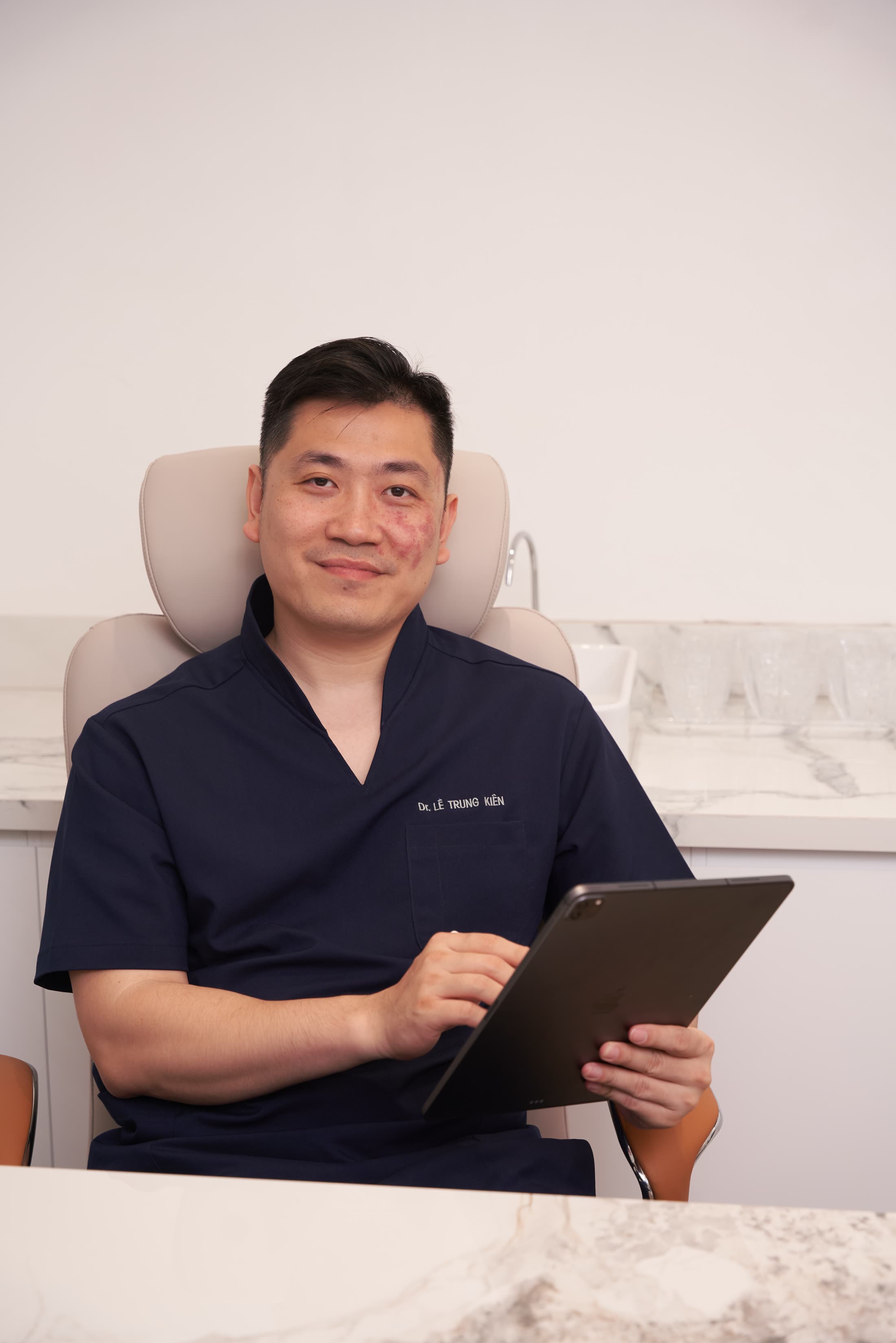
Author
Dr. Le Trung Kien
RASA Surgical Practice
"A quiet reflection on patients who return to themselves after years of carrying a body that no longer feels familiar."
In my consulting room, there is a type of patient I encounter more than any other, and rarely speak about.
They usually come alone. Often sit down and take a while before starting to talk. And when they do talk, the first sentence is usually an apology: "Doctor, I'm sorry, I know I'm old now but..."
Old now but.
Those two words, the way they use age as an excuse before starting, as if they're preparing themselves to hear me say that their desires are unreasonable, for me to see everything I need to know about them in just one sentence.
They have learned very deeply, over many years, that wanting something for themselves is something that needs to be apologized for.
Mrs. Lan and the Mirror in the Toilet
Mrs. Lan came to see me at the age of 62. Alone, without anyone accompanying her. She sat down, placed her handbag on her lap, and said: "Doctor, I know I'm old now, but I want to ask if there's anything that can be done."
I asked her what she wanted. She bent down to open her handbag, took out a folded piece of paper, and unfolded it: it was a photo of herself, taken 25 years ago. She placed it on the table in front of me.
"I want to look a bit like this again. Not exactly the same."
I looked at the photo. The woman in it was 37 years old, smiling, with short hair, and bright eyes. Then I looked at Mrs. Lan sitting in front of me. And I asked: "What happened between those 25 years, Mrs. Lan, "
Mrs. Im is silent. Then she says: "My husband has been ill for twelve years. I've taken care of him and raised three children. He passed away last year. Now my children have their own families. I look into the mirror in the toilet every morning and no longer recognize myself."

Khi nhu cầu làm đẹp là lời xác nhận sự hiện diện
No longer recognize myself.
I sit in silence for a moment with those words. Because I know Mrs. Im didn't come to see me to look good. She came to find the woman in that photo. Not her face at 37. But the light in the woman's eyes, the feeling of still being herself, still present, still countable.
We talk for over an hour. Not much about the technique. More about her. About those twelve years. About how her husband passed away and she stood in the empty house and for the first time in a long time didn't know what to do next, not because she had nothing to do, but because her entire life had been organized around someone else, and now that someone else was no longer there.
Finally, she asks: "So, doctor, can you do it, " I say yes. We discuss a small, suitable, realistic case. She nods, puts the photo back in her bag, stands up. And before leaving, she turns around and says: "Thank you, doctor, for not laughing at me."
I was taken aback by that statement for a few seconds. Then I asked, "Ma'am, do you think I would laugh at you for what reason, " She thought for a moment and said, "Because of the demands. At this age, still demanding."
Demands.
The word she used to describe wanting to see oneself in the mirror.
""I have sat with many people sharing my story, and what hurts me is not what happened to them. But how they apologize for letting that happen." - Dr. Lê Trung Kiên
What nobody says out loud: Our society teaches women to disappear
I want to say this directly, even though it will make many people uncomfortable.
Vietnamese society, and not just Vietnam, has been and continues to teach women that self-erasure is a virtue. A good woman is one who sacrifices, who puts her husband and children first, who doesn't "demand", who doesn't "make a fuss", who doesn't spend time on herself when there are household chores, children, husband, mother-in-law, and company work to attend to.
And the most insidious trap of this logic is that it's not just imposed from the outside. After living by it for many years, women impose it on themselves. They feel guilty when they buy themselves a new outfit while their children still need tuition fees. They feel selfish when they spend an afternoon on themselves while their husband hasn't eaten yet. They learn to feel no hunger, no fatigue, no sadness, no desire.
And then one day, usually when their children are grown, or when their husband is no longer there, or when they stand in front of the mirror and don't recognize the person staring back at them, they start asking: who am I if I'm not a wife, a mother, a child, a servant, What do I want for myself,
And that question, because there's nowhere else to ask it, sometimes ends up in my consulting room.
It's not because surgery is the answer. It's because surgery is the only thing they can think of when they finally allow themselves to want something, after a lifetime of not wanting anything. And that something, whether it's eyelid surgery or tummy tuck or anything else, isn't really about appearance. It's about existing. It's about being counted. It's about saying: I'm still here.

Cơ thể như nơi lưu giữ những năm tháng đã đi qua
""Some patients come to see me not to be more beautiful. They come to want something for the first time in many years." - Dr. Lê Trung Kiên
The man who doesn't know the name of his pain
Women are not the only ones who carry this.
I have male patients who come with something else but the same root cause. Vietnamese men are taught not to be weak. Not to talk about emotions. Not to admit that something is hurting inside. They learn to suppress everything and keep going.
And sometimes, after ten or twenty years of repression, that unnamed pain finds its way out through the only language allowed: the body.
I remember a man, around 48 years old, the director of a small company in Hanoi. He came to see me about gynecomastia, breast enlargement in men. Not a severe case from a clinical perspective. But he had carried it for thirty years, since high school, since his friends teased him at the pool. Thirty years of not daring to take off his shirt at the beach. Thirty years of wearing a vest under his clothes in the sweltering Hanoi summer.
He told me that as if it were a report he was reading, his voice steady, his eyes straight ahead. But when he said "thirty years of not daring to take off his shirt to go to the beach with his wife and children," his voice faltered slightly. Just slightly. Then he continued.
Thirty years.
I thought about those thirty years. About all the beach trips he sat on the shore with a shirt on. About all the times his children ran into the water while he watched from afar. About the silent price he paid for something small that no one knew he was paying.
I performed the surgery. It wasn't technically complicated. However, when the patient came back for a follow-up appointment, he mentioned that this summer was the first time in thirty years he had gone to the beach with his child. He didn't say anything else. I didn't ask anything else either. There are things that don't need to be said.
The Girl from the Factory
Not every story in my counseling room is about someone who is wealthy.
One afternoon, a 26-year-old girl came to see me. Her uniform was still unwashed, and her hands still had oil stains from the factory. She worked as a nurse at an electronics factory in the outskirts of Hanoi, working from 6 am to 6 pm, six days a week.
She had saved for over a year and a half to have enough money for eye surgery. It wasn't a lot of money, but with her salary, saving for that long was a long time.
I asked her why she wanted to do it. She said, "I've gone to apply for office jobs several times, but they just look at my photo and don't call me back. I know I'm not good enough compared to others." Then she stopped, and added softly, "And I want, just once, to look in the mirror and feel okay."
Look in the mirror and feel okay.
Those words hung in the air for a moment.
I didn't want to analyze those words in an academic way. I didn't want to talk about the impact of beauty standards or discrimination in hiring. All those things are true and important. But in front of me at that moment was a specific person who had worked for a year and a half and saved up every penny to buy something that all of us deserve without having to pay for it: the feeling of looking okay in the mirror.

Tìm lại mình sau một đời sống vì người khác
I performed that procedure. And I added to my costs the weight that I felt from her story, in a way that no textbook or surgical record could account for.
""She spent a year and a half to buy a sense of looking okay in the mirror. Society should have given her that for free a long time ago." - Dr. CKII Lê Trung Kiên
The question I couldn't answer
I am a surgeon. I intervene in the human body. I cannot change the way society looks at a 60-year-old woman and no longer sees her. I cannot fix the discriminatory hiring system based on appearance. I cannot give Mrs. Lan back the twenty-five years that have passed.
There are evenings when I come home and sit thinking about the patients of the day, and the question keeps haunting me: am I helping them, or am I just a link in the system that is causing the thing that makes them come to see me,
When I help Mrs. Lan look in the mirror and see herself, I am doing something good. I believe that. But at the same time, the reason she feels the need to apologize before asking me, the reason she calls wanting to see herself a 'demand', is something I cannot resolve. I only resolve the symptoms, not the cause.
The underlying reason is far more complex. It lies in the fact that a five-year-old girl learns that her sister is not allowed to be loud. It lies in the fact that a young woman learns that wanting something for herself is selfish. It lies in the fact that a mature woman learns that her value lies in how many people she can serve, not in who she is. And when those lessons accumulate to a sufficient weight, they come to my counseling room and apologize before asking.
I have no answer to that question. I can only do what I can, one person at a time, and try to do it well.
What I have learned from these people
They have taught me something that no medical school teaches.
That a person's body is not just a body. It is a place where a person stores their history, unnamed wounds, lived and unlived years, permitted and never-permitted things. When someone points to a part of their body and says 'I want to change this', they are not just talking about their body.
That the desire to see oneself in the mirror, to be recognized, to feel present in one's own body, is not a luxury or a trivial matter. It is the basic aspect of being human. And the reality that some people must wait a year and a half's salary or apologize before asking to get it is something we should sit with and feel uncomfortable about seriously.
That plastic surgeons, whether they want to or not, stand in a very peculiar place in society: a place where people come when they finally allow themselves to want something, or when they are trying to find themselves again after losing themselves for too long. That place requires more than just good surgical technique. It requires the ability to listen. To recognize. To know that sometimes the most important thing you can do for the person sitting in front of you is not to hold a scalpel, but to look into their eyes and say: I hear you. I don't see you 'demanding'. I see you still here.
""What people actually bring into the operating room is often not what they say. Learning to hear the unsaid is the hardest part of this profession." - Dr. Lê Trung Kiên
And Mrs. Lan
I still think about Mrs. Lan.
It's not because the surgery is anything special. From a technical standpoint, it's a routine case. I think about her because of the photo she kept in her pocket for twenty-five years. Because of the way she carefully folded it after showing it to me, as if it were a precious item.
I don't think she kept the photo because she wanted to turn back the clock to age 37. No one wants to reverse time in the literal sense. She kept it because the woman in the photo still looked out at the world with the eyes of someone who believed she had a place in it. And after twelve years of caring for her ailing husband and twenty-five years of doing all the things society assigns to women, that gaze gradually faded away without anyone noticing.
What she was searching for in my consultation room wasn't a younger face. It was that gaze.
And that's something I'm not sure I can restore to her with any surgery. But I hope, by sitting down and listening to her, by not laughing and not making her feel 'entitled,' I've done a small part of that.
There are things that are very small. And sometimes it's those very small things that are all we have to give each other.
Dr. CKII Le Trung Kien
Senior Specialist in Plastic Surgery with many years of clinical practice. All characters in this article have been anonymized. This is a professional observation and the thoughts of the author from the consultation room to home.