
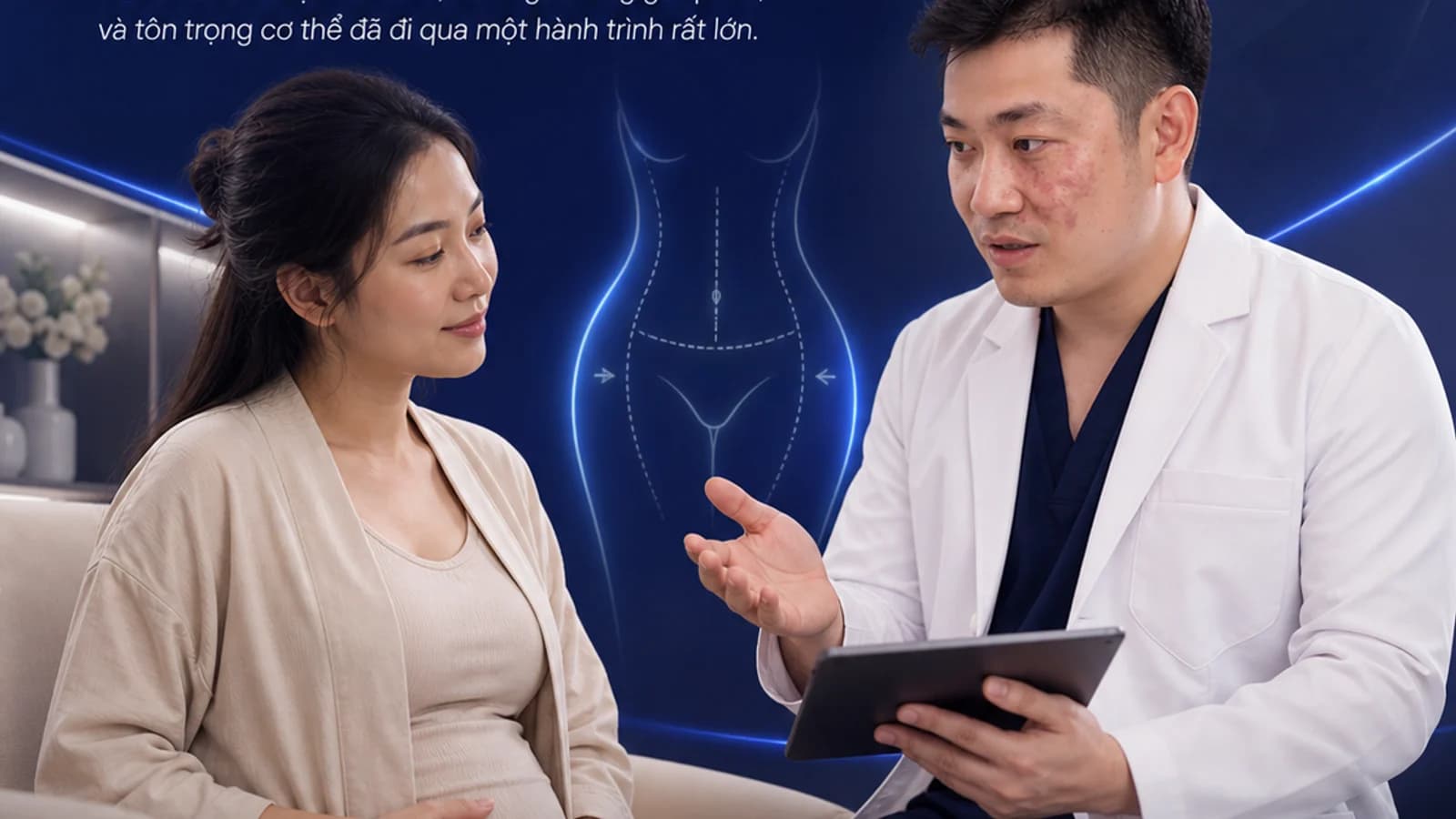
A Body That Has Given Birth Is Not a "Broken" Body
Author
Dr. Le Trung Kien
RASA Surgical Practice
"A human-centered perspective on postpartum women, body sculpting and respect for the body."
THINKING AND PHILOSOPHY OF SURGERY
After more than a decade in reconstructive and aesthetic surgery, I have learned to read a patient?s body language before they begin to speak. There is a profound difference between the way a twenty-two-year-old woman enters a consultation asking about thigh liposuction, and the way a thirty-five-year-old mother of two comes in to ask about her abdomen.
The postpartum woman often carries a very heavy invisible burden. It is guilt.
She sits down, places her bag aside and clasps her hands together. When I ask to examine her clinically, the act of lifting her shirt often comes with something almost like an apology. Many women say: doctor, please understand, my abdomen is ruined. Others ask, with hesitation, whether it looks terrible.
The word ruined appears so often that it becomes haunting. It is as if their body were a precious object damaged by a great journey, and I am the last person they come to in the hope of being repaired.
I often have to pause, look directly at them, and say something they may never have heard from anyone, not even from their own inner voice: your body is not ruined. It created a human being.
This article is not only about liposuction, abdominoplasty or skin tightening. It is about a deep crisis of perception that modern society places on women, and about the true role of reconstructive surgery in redefining respect for the body.
The anatomy of life: what really happens beneath the skin
To understand why calling a postpartum body ruined is wrong, we must look at it through physiology and layered anatomy. During pregnancy, a woman?s body does not simply become larger. It undergoes a profound restructuring at the microscopic level. Muscles, fascia, fat layers and skin all exceed their usual elastic limits to create space for another life to grow.
Consider the fibroseptal network beneath the skin. I often describe it as thousands of tiny elastic cords anchoring the skin to deeper fascial structures. Its role is to prevent the skin from sliding loosely while also shaping the fat compartments. During pregnancy, fetal volume, amniotic fluid and physiological volume expansion stretch these fibrous septa continuously.
Once physical elasticity is exceeded, collagen and elastin fibers inside this network can be maximally stretched, micro-injured or disrupted. After delivery, internal volume decreases suddenly, but this scaffold cannot immediately contract like a rubber band. The mesh has slackened. Clinically, this appears as skin laxity, wrinkling and looseness.
Beneath the fat layer, the story can be even clearer. The rectus abdominis muscles, the muscles associated with the abdominal six-pack, may be pushed apart by internal force. The linea alba, the strong central tendon line, can become significantly stretched and thinned. This is rectus diastasis. Even after pregnancy weight has been lost, diastasis may still make the abdomen project forward because part of the mechanical tension of the abdominal wall has been lost.
Stretch marks, tissue laxity, localized fat accumulation influenced by pregnancy weight gain, hormonal shifts, movement, sleep, metabolism and individual biology, or varying degrees of rectus diastasis are not signs of failure. They are physical evidence of life. The mother?s body functioned exactly as biological evolution designed it to function, protecting the existence of the fetus. When I see a stretched and lax abdomen, I do not see only an aesthetic problem to be corrected. I see a masterpiece of endurance. How can we call a body that has passed through such a demanding journey ruined?
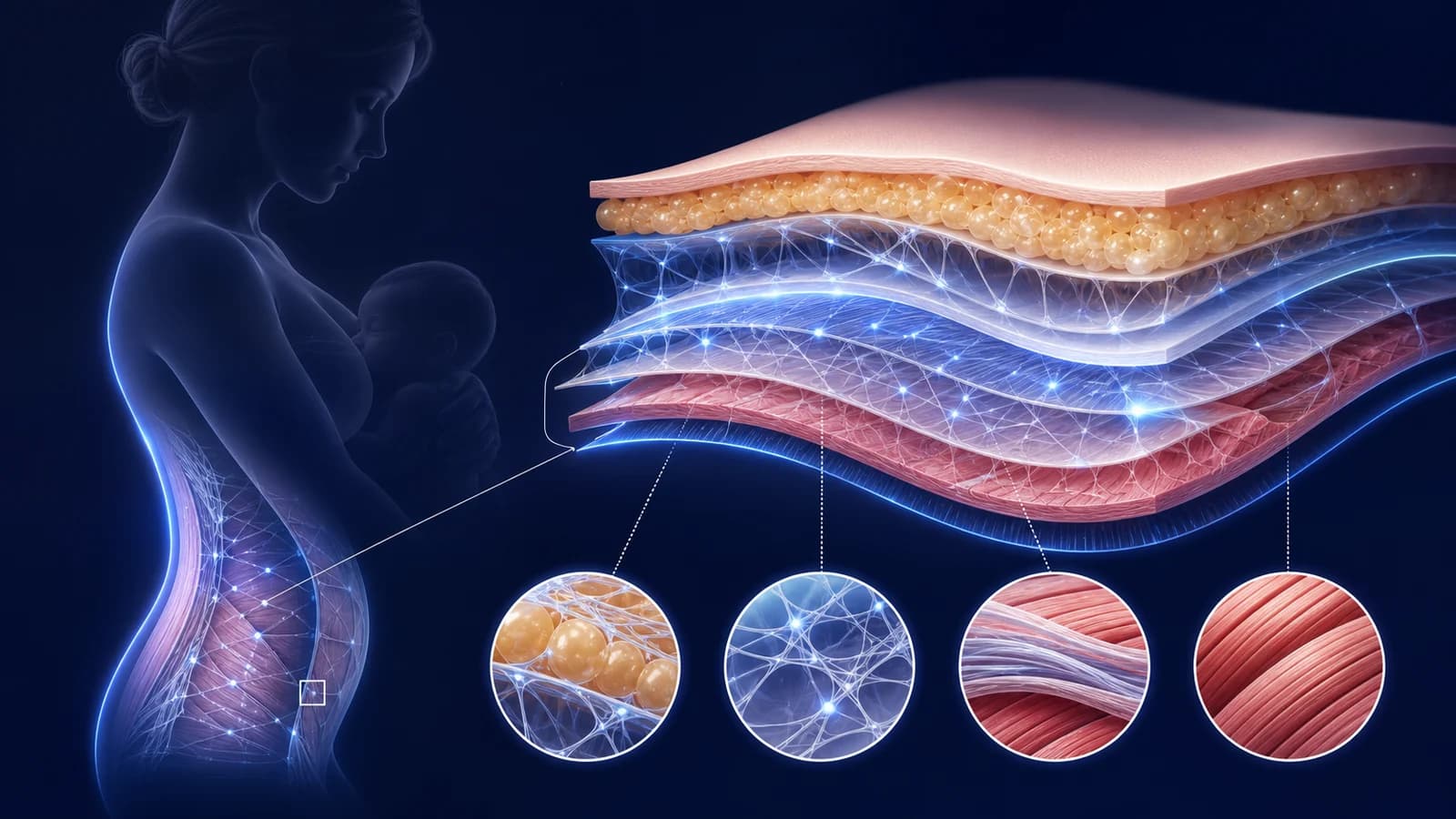
Layered anatomy and support structures of the postpartum abdomen
A culture of guilt and body pressure
Why, then, do these women enter the consultation room with shame?
The answer is not anatomical. It lies in the way society operates. We live within a culture filled with assumptions about motherhood. On one hand, society praises maternal sacrifice with beautiful words. On the other, images and expectations about regaining one?s figure quickly place enormous pressure on women.
Open a phone and you may see countless images of public figures showing a flat waist only weeks after giving birth. The hidden message is that if you are a valuable woman, you must give birth, but your body must look as if it never carried a pregnancy. This creates an unrealistic expectation that works against many laws of biology and physics. Ordinary women look in the mirror and feel that they have failed.
They begin to reject the very abdomen that protected their child. They wear loose shirts at home, avoid mirrors and feel a strange guilt for having lost part of their aesthetic value. The beauty industry sometimes deepens this fear by marketing services through women?s insecurity. We teach women to sacrifice for their children, then quietly make them pay with peace inside their own bodies.
Body sculpting surgery: a tool for liberation
If I reject a negative view of the postpartum body, why do I still perform body contouring, abdominoplasty and liposuction for postpartum women?
Because accepting physiological truth does not mean women must quietly tolerate discomfort within their own bodies. A mother has every right to love her child unconditionally while also wishing to close a rectus diastasis if it affects core stability or quality of life. She has the right to be proud of her stretch marks and still choose medical technology to address subcutaneous fat in superficial and deep compartments that exercise alone may not improve.
The issue lies in motivation and surgical philosophy.
When a postpartum woman comes to see me, my clinical goal is never to erase the past and create an artificial body. Tissue biology does not allow that, and medical ethics should not encourage it. The philosophy at RASA Reconstructive and Aesthetic Surgery Alliance is directed toward restoration and liberation. We use evidence-based medicine and appropriate technology to address the limits that the body cannot resolve on its own.
What the surgeon needs to hear: the words left unsaid
No matter how advanced a technique may be, it is still only a tool. The real boundary between a procedural doctor and a reconstructive specialist lies in the ability to listen and understand the patient?s psychology.
When a patient says she wants to remove this excess fat, what she may really mean is that she wants to feel like an independent and attractive individual again, not only someone confined to the role of mother. I have declined surgery in some cases. Not because it was technically impossible, but because the conversation revealed that rejection of the body was being driven by comments from others. When the voice pushing surgery does not belong to the patient herself, medical intervention will not bring peace of mind.
But when a woman tells me that she knows she cannot return to exactly who she was before, that she is proud of her children, yet every morning she looks in the mirror and feels tired and wants to do something for herself so she can feel healthier, that is when medicine can become deeply human. It is an active choice. It is her own freedom.

Respectful recovery and body dignity after pregnancy
A surgeon does not repair something broken
A surgeon does not create beauty by adding lifeless form. A surgeon uses anatomical knowledge, the language of light and shadow across body tissues, and appropriate medical tools to remove the barriers that obscure a woman?s natural form.
I want to say this to every woman who has become a mother. Your body is a wonder of nature. It carries the history of sleepless nights, the expansion of fascia, and the rhythm of life itself. It is sacred and profoundly strong. If you choose to keep that body with all its marks, you are beautiful. The world?s respect for you must never depend on surface measurements.
But if you choose medicine and reconstructive surgery to refine your shape, restore confidence and reconnect with your personal sense of self, that too is a valid act of self-care. Do it as a gift to yourself, not as an apology for having ruined anything.
You are not ruined. You are entering a new chapter of life. The task of surgeons like us is not to help you reject the past, but to help you feel radiant, steady and whole in the body you live in now.
Professional note: This article is intended to provide medical information and professional perspective. It does not replace direct examination, diagnosis or individualized treatment indication. Each case should be assessed directly by a specialist before any intervention is considered.