

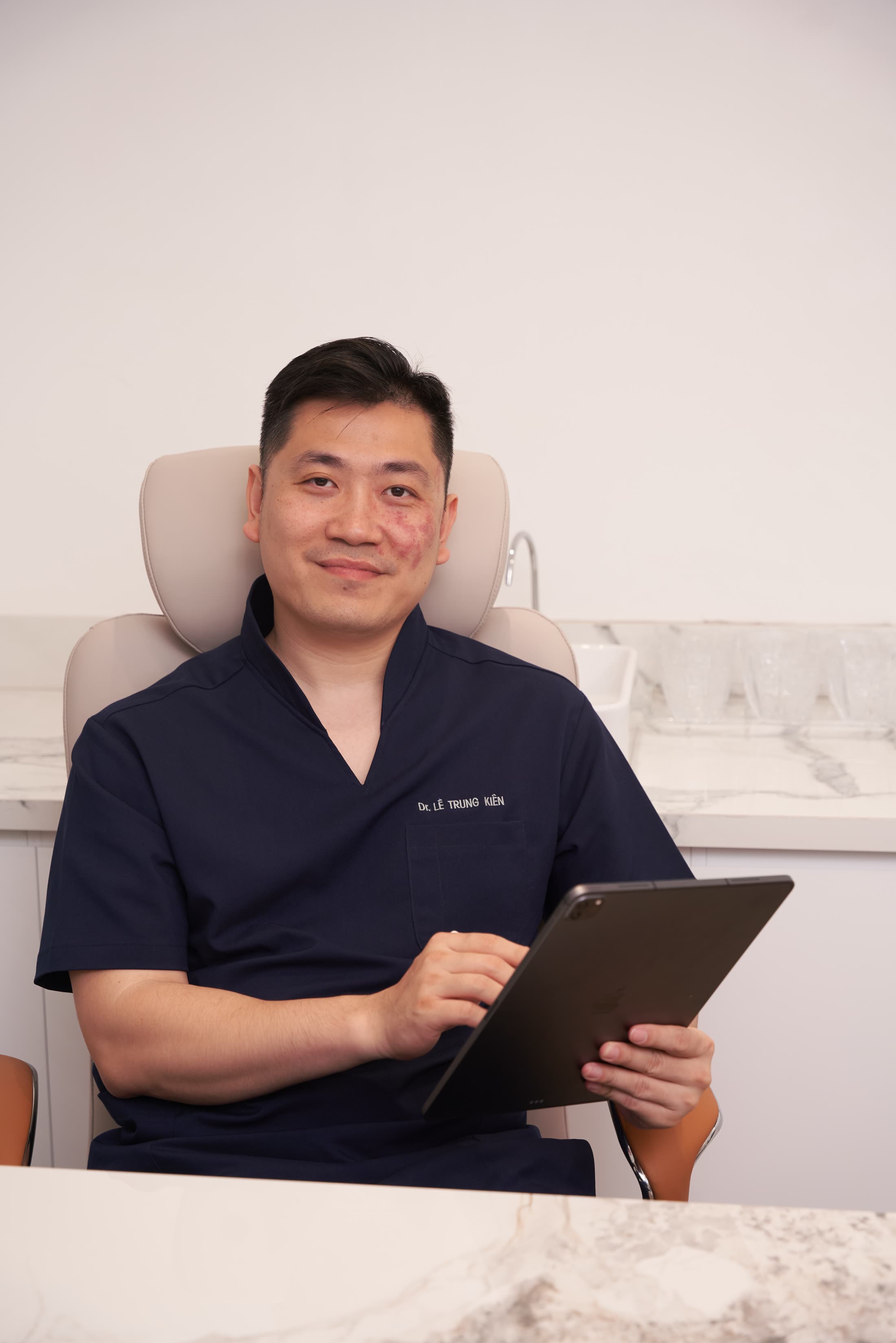
Author
Dr. Le Trung Kien
RASA Surgical Practice
"Sometimes the most responsible consultation is the one that ends without surgery. A reflection on restraint, trust and saying no."
There are mornings I walk into the consultation room, sit down in front of a patient, look into their eyes, and immediately know: what they need is not what I have.
Not because they are not technically suitable. Not because the case is too complex or the risk is too high. But because the wound they carry is not where they point to on their body.
I don't know how to say this without sounding judgmental. But this is the truth I've learned after many years sitting in that room, listening to people talk about their bodies with a pain that is not entirely about their bodies: I've met the saddest patient I've ever seen, and they weren't sad about their appearance. They were sad about something else. And they came to see me because they hadn't found the words to name it yet.
The Mother and Her Daughter's Nose
I'll tell you about a consultation that still comes to mind.
A woman in her early 50s accompanied a young girl, approximately 19 or 20 years old. The mother sat down, the daughter sat beside her, and the person speaking throughout the day was the mother. The girl remained almost silent, just sitting.
The mother pointed to her daughter's nose and said, "Doctor, can you fix this nose, " Then pointed to her eyes: "This one-mirrored eye looks very sad." Then turned to me with an expression describing something that needed repair: "In general, we need to make it brighter, as it looks dull, and she's about to take the university entrance exam soon."
I looked at the girl. She was looking down at her hands.
I asked her, "How do you feel, What do you want to change, " She looked up at me quickly, then at her mother. Then said softly, "Yes, as mother wishes."
As mother wishes.
I didn't perform the surgery. I told the mother that I needed to speak with the girl privately, that this was a mandatory procedure. The mother wasn't pleased, but agreed to step outside. When only the two of us were left, I asked her: do you really want to do this, She remained silent for a long time. Then said: 'I don't know anymore, doctor. Mother has been saying that since I was a child.'
Since I was a child.
I didn't perform the surgery. Not because I thought she didn't have the right to change her physical appearance. But because I didn't want my scalpel to become a tool to complete something she had never been given the right to decide for herself.
""There are cases I refuse not because the technique is impossible. But because I don't want to be the one to tell them that their body is not enough." - Dr. CKII Lê Trung Kiên
The woman who wants to become someone else
She came about three months after the divorce. I knew that because she told me, not because I asked.

Có những vết thương không nằm ở nơi bệnh nhân chỉ vào
She wanted to do a nose job, eye surgery, liposuction, and breast lift all at once if possible. "Do it all at once and be done," she said. She brought a handwritten list, very detailed, like a shopping list. I read through it and realized: this wasn't a list of things she wanted to add to herself. This was a list of things she wanted to get rid of.
We talked for over an hour. Not about the technique, but about her. And gradually a picture emerged: her ex-husband had been comparing her to others for many years. She had learned to see herself through his eyes, and now that he was no longer there, she still saw herself that way, with no other choice.
I asked her: "If I do all the things on this list, how do you think you'll feel, " She thought for a moment. Then said: "Better." I asked her: "Better than who, " This time she couldn't answer right away. And in the silence, I think we both knew the answer.
I didn't say no to her that day. I said: "I want you to come back and see me in three months. If you still want the things on this list, I'll do them." She looked at me as if I had just refused to give her the pain medication she so desperately needed.
She didn't come back. I don't know what she did afterwards, whether she went to another clinic or how her life is now. This is something I often sit with: I don't know if my decision that day was the right one. I only know I couldn't have done anything differently.
The Cost of the Question "How Do You See Her"
I don't have exact statistics, but my estimate after many years of counseling is that about one-third of young female patients who come to my clinic, especially those under 25, come because of the opinion of a man in their lives. A boyfriend, an ex-boyfriend, a father, a brother.
Not always direct. Sometimes it's just: "He always says you look too young." Or: "He prefers a more angular face." Or simply a careless comment that was made once and the girl has carried it with her ever since, not knowing when it became her inner voice.
What I fear most isn't the patients who directly say "he wants me to do this." Those cases I recognize immediately and know how to handle. What I fear most are the cases where the patient completely believes this is their own decision, while the voice leading to that decision was never theirs. Those cases I don't always discover in time.
And this is when I must be honest with my profession: there have been cases I've done where I'm not even sure I asked enough questions afterwards. The patient is satisfied from a technical standpoint. But whether they truly feel lighter afterwards, or they just have something else to look at in the mirror and evaluate, I don't know. This is the kind of uncertainty I have to live with.
THE SIGNS I'VE LEARNED TO PAY ATTENTION TO
• The patient describes "the problem" in someone else's language: "people often say...", "he likes the kind of...", "my mom says..."

Giới hạn của phẫu thuật trước những tổn thương tâm lý
• The list of things they want to change is too long and lacks a clear priority order, as if changing enough things will be enough
• They cannot answer the question: after it's all done, how do you want to feel, The answer is just "looking better" or "different"
• This patient has undergone many procedures previously but still returns, and each time the issue is a different area.
• When asked "what do you like about your appearance", the patient remains silent for a long time or is unable to respond.
The Patient Who Returns for the Fifth Time
I have a patient who has visited my clinic four times over the past two years. Each time, a different area was treated. The first time was the nose. The second time was the eyes. The third time was liposuction of the abdomen. The fourth time was a facelift. All procedures were technically successful.
On her fifth visit, I asked, "What do you want to do this time, " She smiled, slightly lost, and said, "I don't know anymore, doctor. But I still feel like something is missing."
She was missing something.
I paused for a long time before that sentence. Because I knew the feeling of "missing something" she was describing wasn't a detail on her face or body that I could fill in. And if I just kept filling it in, I wouldn't be helping her, I'd be perpetuating a loop with no end.
I didn't see her on Fridays. Instead, I told her, "I don't think what you're missing is anywhere on your face or body. I want you to talk to someone who can help you figure out where it really is, before we decide if we need to do anything else." Then I introduced her to a psychologist I knew.
She fell silent for a moment, then asked, "Doctor, do you think I have a psychological problem, " Her tone wasn't a question, it was an insult.

Lắng nghe là một phần của chỉ định có trách nhiệm
I said, "No. I mean you're looking for something very important, and I want you to find it in the right place."
She didn't come back to see me after that. I don't know if she went to see the person I introduced her to. This is a type of ending not found in surgical textbooks: not successful, not failed, just a person walking out the door and you don't know where they'll find what they need, or if they'll find anything at all.
""The worst outcome isn't a post-operative complication. It's a technically perfect surgery that accomplishes nothing for the person on the operating table." - Dr. Lê Trung Kiên
What no one taught me in medical school
The plastic surgery training program taught me how to evaluate skin elasticity, how to calculate tumescent doses, and how to handle seroma complications. All of those things I needed and I'm grateful to those who taught me.
But no one taught me how to recognize when a patient is using the consultation room as a confessional. No one taught me how to ask a simple question like 'what's really hurting you' without making the person in front of me feel judged or hurt. No one taught me how to decline a case without making the patient feel rejected once again.
And no one taught me how to live with the uncertainty of whether my decisions to refuse would truly help anyone, or if I was just pushing people out the door while telling myself I was doing the right thing.
I learned those things in the consultation room, one case at a time, over many years. And every time I thought I had understood a little more, another case would come along and remind me that I still had a lot to learn.
What I want to say to the person reading this
If you are reading this and considering plastic surgery, I am not writing to persuade you to do it or not to do it. That is your decision and your doctor's.
But I want to ask you a question, a question I often ask my patients and not everyone can answer right away: if no one else knew you had undergone this surgery, would you still want to do it,
It's not to test or to trap. Rather, the answer to that question reveals a lot about what you're looking for. If the answer is yes, you do it for yourself. If the answer is uncertain, or requires more thought, then the most valuable thing you can do is sit with that question before doing anything else.
Surgery can change many things. But it can't change the way you look in the mirror and listen to the voice inside yourself. That voice, whether it's your own voice or the voice of someone else that's been in your head for so long it's become your own, is the only one you can handle. No scalpel can change that.
And if you're carrying someone else's voice that makes you feel insufficient, I want you to know this: that voice is wrong. Not your body.
""I've met many beautiful people in every sense of the word, sitting in front of me and not seeing that. That's a wound that no surgery can heal." - Dr. Lê Trung Kiên
Why I still do this job
Some people ask me: after all the things I've told them, why don't I get discouraged with my job,
I've been thinking about this for a while before answering.
I still do this job because I've seen the opposite happen. A woman who's had children for 30 years and never looked in the mirror finally comes to see me because she wants to get back something of herself, not because anyone's asked her to, but because she's finally allowed herself to want it. A man who's avoided bright light for ten years because he's ashamed of his body finally dares to go to the beach with his children after the first surgery. Young people with congenital deformities small enough to tease them their whole lives are restored not just physically.
Cosmetic surgery, when done for the right reasons and at the right time, isn't about changing someone into someone else. It's about helping people get back to themselves, or sometimes, for the first time in their lives, be themselves.
The difference between that case and the ones I turn down isn't in the technique or complexity. It's in the question the patient is really asking. And after many years, I'm still learning to listen carefully enough to understand what that question really is.
That is a job that will never be finished. But I do not know any other profession that is more worthy of doing.
Dr. CKII Lê Trung Kiên
Plastic Surgeon specializing in advanced body sculpting with many years of practice. All cases mentioned in this article have been anonymized. This is a reflective piece on the profession, not a clinical case study.