

Liposuction and Body Contouring: What to Know Before Deciding
Author
Dr. Le Trung Kien
RASA Surgical Practice
"Fat is not a single uniform layer. Understanding anatomy is essential before deciding where to remove, preserve or shape tissue."
Expert Analysis by Dr. Lê Trung Kiên
Fat is not a homogeneous substance. This may seem counterintuitive to what people commonly think, but it is a surgical fact that any plastic surgeon needs to understand before picking up a cannula. Subcutaneous fat and visceral fat have different embryonic origins, different metabolic mechanisms, and most importantly, different reactions to surgery. Liposuction only affects the subcutaneous layer, leaving the visceral layer untouched. This is the first thing patients need to understand.
I usually spend most of the first consultation explaining this. Not because patients ask, but because if we overlook it, everything that happens afterwards can lead to unrealistic expectations. A person with a large belly primarily due to visceral fat will see surface-level improvements after liposuction, but the belly size will not change significantly. This is not a failure of the surgery. It is a biological limit that no technology can surpass.
This article is not intended to promote a specific technique or device. The current market offers too many options, from traditional liposuction to VASER, BodyTite, SmartLipo, J-Plasma (Renuvion), Body-Jet, and dozens of variations. Each has its place. The surgeon's task is to choose the right tool for the right patient, not to sell the patient what they have.
The Anatomy of Fat: A Foundation for All Subsequent Decisions
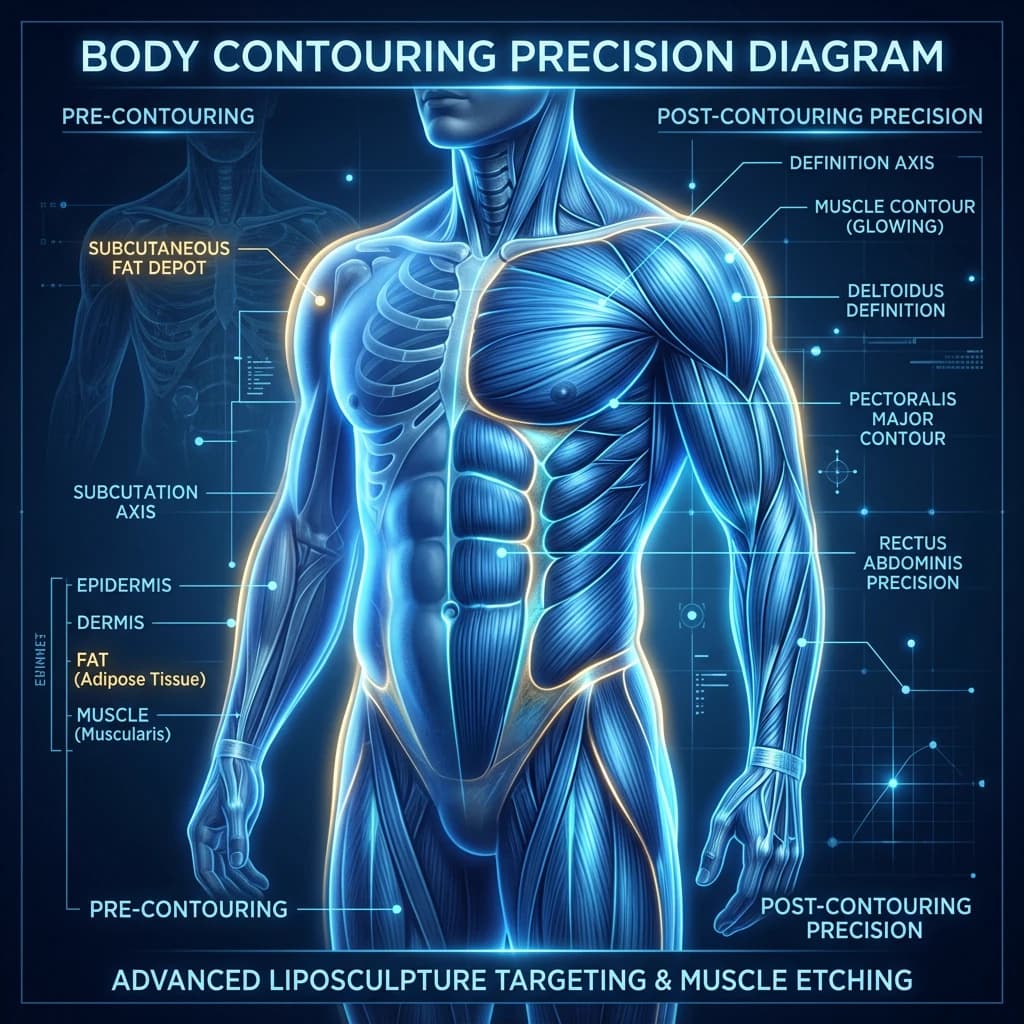
The subcutaneous fat layer is divided into two tiers by the fascia superficialis: the superficial compartment and the deep compartment. These two tiers have different densities of collagen fibers, vascular structures, and mechanical properties. The deep compartment typically has fewer collagen fibers, is easier to remove, and has fewer contour irregularities. The superficial compartment has more collagen fibers, smaller lymphatic vessels, and incorrect surgical techniques can result in an uneven surface.
This has practical implications: not all areas can be treated with the same protocol. The upper and lower abdominal regions have different fat layer distributions. The inner thigh area has a very thin superficial compartment and many sensory nerve structures, requiring extremely delicate manipulation. The upper back area typically has a lot of fibrotic fat, making it difficult to achieve results with standard liposuction, and often requires energy-assisted techniques like VASER or BodyTite.
Another factor that is often overlooked is that fat distribution is heavily influenced by sex and hormonal changes. Women tend to accumulate fat primarily in the gluteofemoral region (thighs, hips, buttocks) as a reproductive protective mechanism. Men tend to accumulate fat primarily in the abdominal region, which is often visceral fat. Postmenopausal fat redistribution or changes in hormone levels can completely alter this picture. Doctors cannot simply evaluate patients based on images; they need to perform a physical examination.
""The same amount of fat needs to be removed, but the location, tier, and tissue structure determine which tool to use. This is why I don't have a fixed protocol for all patients." - Dr. Lê Trung Kiên
Evaluating patients: Questions doctors must answer before surgery
One of the systemic errors in the field of aesthetics is overlooking the evaluation stage. The patient arrives, wants liposuction, and the doctor quickly examines and prescribes. That process may run smoothly, but it is not enough to ensure good results and safety.
Firstly, the skin condition. The elasticity of the skin (skin laxity) determines whether liposuction alone is sufficient or if additional skin tightening technology (skin tightening) or traditional surgical excision is needed. The simplest way to check is through the pinch test and observing the skin's recovery after stretching. Patients over 40 years old, those who have given birth, or those who have experienced significant weight loss are almost certainly in need of a combined approach.
Secondly, the volume of fat to be removed. The current safety guidelines recommend not removing more than 5,000ml of aspiration (total aspirated volume including fat and tumescent fluid) in a single outpatient procedure. Exceeding this amount significantly increases the risk of electrolyte imbalance, decreased circulatory volume, and post-operative complications, requiring evaluation to determine whether hospitalization for monitoring is necessary. Some cases may require multiple procedures.
Thirdly, the patient's medical history and medication use. Bleeding disorders, uncontrolled diabetes, and smoking are the top three red flags. Patients taking anticoagulant medications, NSAIDs, or high doses of omega-3 fatty acids must stop taking them for a sufficient period before the procedure. This is not a bureaucratic procedure, but rather a measure to control complications.

Hiểu đúng lớp mỡ trước khi quyết định hút mỡ
Fourthly, and no less importantly: are the patient's expectations realistic, I have encountered patients who bring pictures of others and say they want to have a body like that. This is a signal to stop and have an open discussion. Plastic surgery is about optimizing the patient's body, not copying someone else's features onto another person's body.
BODY TYPES NOT SUITABLE FOR LIPOSUCTION
• Primarily visceral fat due to excess weight: BMI above 30 with large waist circumference not commensurate with subcutaneous fat
• Significant skin sagging after major weight loss: requires skin excision beforehand or concurrently, as liposuction alone will exacerbate the condition
• Expectations of weight loss: liposuction is for sculpting body contours, not treating obesity
• Underlying medical conditions not yet controlled: diabetes, hypertension, coagulopathy require stabilization before considering liposuction
The Map of Technology: Understanding to Choose Correctly, Not the Most Expensive
When patients ask 'which technology is the best', the correct answer is: what is the best for your specific case. There is no technology that is superior in all situations. This may sound unsatisfying to patients, but it is the truth.
Traditional Manual Liposuction (SAL, Suction-Assisted Liposuction) is still the foundation of all techniques. The cannula is connected to a vacuum pressure, and the doctor moves it manually. Suitable for soft fat areas, less fibrosis, and moderate volume. The lowest cost, completely controlled by the doctor's hands. The disadvantage is that it is more tiring for long cases and not suitable for fibrotic fat.
PAL (Power-Assisted Liposuction), exemplified by MicroAire, is a mechanically oscillating cannula at high frequency. It significantly reduces the doctor's hand force in long cases, making it easier to move through fibrotic tissue. The clinical results are similar to SAL, but the doctor is less tired in complex cases, which indirectly helps to improve the quality of surgery.
VASER (Vibration Amplification of Sound Energy at Resonance), ultrasound-assisted technology, uses ultrasound waves to break down fat cell membranes before suctioning. Allows for more fat removal with less damage to blood vessels and nerves compared to SAL. Especially effective for fibrotic fat in the back, male chest (gynecomastia), and areas that have been previously intervened. VASER also enables safer removal of superficial fat, supporting the recreation of muscle lines for high-definition liposuction.
BodyTite (RFAL, Radiofrequency-Assisted Liposuction), by Inmode, places RF electrodes both inside and outside the skin to heat simultaneously from both sides. Tissue contraction is approximately 30 to 40%. The advantage is the integration of liposuction and skin tightening in a single procedure. Suitable for cases with loose to moderately loose skin combined with a moderate amount of fat to be removed.
SmartLipo (LAL, Laser-Assisted Liposuction), uses laser energy with a wavelength of 1064nm or 1440nm to melt fat and stimulate collagen. Skin tightening effect is present but limited compared to RF or plasma. Suitable for small areas, loose skin, and patients who prefer a smaller procedure. Procedure time is longer than SAL due to the additional laser step.
Tạo hình cơ thể cần đọc giải phẫu, không chỉ giảm số đo
J-Plasma/Renuvion (Apyx Medical), distributed in Vietnam by Viet Can, is the only technology currently clearly approved by the US FDA for skin contraction under the skin after liposuction. It combines helium plasma and RF, creating extremely short heat (0.04 to 0.08 seconds at 85°C) followed by immediate cooling. Immediate skin contraction is 30 to 50%, with continued improvement up to 6 to 9 months later. Typically indicated after VASER or SAL to address remaining skin that liposuction did not resolve.
Body-Jet (WAL, Water-Assisted Liposuction), uses water pressure to separate and move fat before suctioning. Lowest cell damage among the methods, suitable when preserving living fat for fat transfer (e.g., BBL, increasing breast volume with autologous fat). Disadvantage is the additional volume of fluid added to the procedure, requiring careful calculation in large liposuction cases.
SELECTING TECHNOLOGY BASED ON LIFESTYLE SITUATION
• Fat with good elasticity: SAL or PAL is sufficient, no need for additional energy
• Fibrotic fat, back, gynecomastia: VASER first, SAL/PAL second
• Loose skin, needs additional elasticity: BodyTite or J-Plasma in combination after liposuction
• Need to harvest living fat for fat transfer: Body-Jet to preserve fat cells
• Loose skin after significant weight loss: surgical excision is the primary indication, not liposuction
Tumescent technique: A Safe Foundation Often Overlooked by Patients
There is a technical factor that most patients are unaware of, yet it accounts for 70% of the safety of liposuction procedures: the tumescent technique.
The tumescent solution consists of normal saline, lidocaine (a local anesthetic), and epinephrine (a vasoconstrictor). Injected into the fatty tissue before liposuction, it performs three functions simultaneously: pain reduction, bleeding reduction, and the creation of intramuscular pressure to facilitate cannula movement. Thanks to the standardized tumescent technique, the average blood loss during liposuction is less than 1% of the patient's total blood volume, a remarkable figure compared to many other surgical procedures.
However, tumescent is also a source of complications if not calculated correctly. Lidocaine accumulation in fatty tissue can reach peak blood levels from 8 to 12 hours after the procedure, not during surgery. This is why lidocaine poisoning often occurs late after the procedure. The safe limit is 35mg/kg of the patient's body weight, not an absolute number. Multiple-region liposuction procedures require careful calculation of total accumulated doses, a practice not always taken seriously enough.
In my practice, I calculate and record the total predicted lidocaine dose for each patient based on their weight and the volume to be treated before each procedure. This is a mandatory procedure, not dependent on the case. If there are limitations on the dose that the patient wants to perform multiple regions, this is the reason to separate the procedure, not to exceed the safe limit.
""I have often been asked: why must we schedule surgeries in shifts, and why is it inconvenient, The answer is: safety is not something that can be negotiated to save time." - Dr. Lê Trung Kiên
Complications: Not to Fear, but to Understand and Prevent
No surgeon is responsible for performing liposuction without preparing for the possibility of complications. And no patient should agree to surgery without being informed about this topic.

Kết quả bền vững đến từ chỉ định và kỹ thuật phù hợp
Early complications most commonly encountered are seroma, a collection of fluid under the skin after fat removal. The body reacts to the empty space by producing lymphatic fluid. Most cases resolve within a few weeks with proper compression garments and lymphatic massage. Larger or persistent seromas require aspiration. The likelihood of occurrence depends on the surgeon's technique and the patient's post-operative compliance, not just chance.
Contour irregularities, uneven skin surfaces after liposuction, are the most persistent and difficult-to-treat complications. Common causes include uneven fat removal between layers, fat removal in areas with previous scars, patients with a history of skin fibrosis, or uneven cannula technique. Some cases improve on their own when edema resolves completely by the fourth to sixth month. Others require additional interventions, such as fractional laser or fat grafting, or even revision liposuction.
Numbness or tingling sensations, as well as increased pain in the treated area, are relatively common complications: nerve damage to smaller sensory nerve branches, which usually recover within 3 to 6 months. Permanent nerve damage is rare but can occur, particularly in the inner thigh and inner forearm areas.
The most common mistake made by patients post-surgery is not wearing a compression garment for the recommended duration. Most centers advise a minimum of 4 to 6 weeks, but in reality, many people stop after 1 to 2 weeks due to inconvenience. This decision can significantly impact the final outcome, and it's not the surgeon's fault.
CHECKLIST FOR SELF-ASSESSMENT BEFORE SCHEDULING A CONSULTATION
• Do I want to change my facial features (create a new shape) or lose weight overall, These two goals require different solutions
• Has my weight been stable for at least 6 months recently, Post-surgery weight fluctuations can affect the outcome
• Can I truly rest and wear compression garments for the recommended time after the procedure,
• Have I read and understood the possible complications that may occur,
• Do I choose a doctor based on their experience and qualifications, or mainly based on price and advertising,
Briefing session standards: What to look for
Patients have limited tools to evaluate a doctor's quality before surgery. However, there is one thing that can be evaluated: the briefing session.
A thorough consultation should include a direct physical examination, not just a look at images or a verbal description. The doctor needs to palpate to assess the thickness of the fat layer, skin elasticity, and palpate to detect existing fibrosis or asymmetry that images cannot see. If the consultation proceeds without the patient needing to undress, that's a red flag.
The doctor should clearly state the limitations of the results, not just make promises. Anyone who guarantees a specific number for the aesthetic outcome is being overly optimistic. The human body is not a construction material, and no two cases are identical. A skilled doctor says, "I expect this outcome, based on my assessment of your case." Not: "It's certain to be like that."
The doctor should explain the specific post-operative plan: what type of compression garment to wear, for how many weeks, when to start lymphatic massage, when to follow up, and what signs to contact immediately. Post-operative care is not the patient's responsibility; it's the doctor's protocol.
And finally: a doctor's refusal is not a bad sign, but a good one. A doctor says, "I don't recommend this technique for your case because..." is a doctor prioritizing the patient's outcome over their own revenue. That's the person you should trust.
""The most important question a patient can ask in the consultation room is not how much it costs, but: why did the doctor choose this technique for me, and not that one, " - Dr. Lê Trung Kiên
What Surgery Cannot Change: The Boundaries of Surgery
Surgical body contouring does not change the skeletal frame ratio. A patient born with a wide pelvis will not have it narrowed by liposuction. A patient with a shoulder wider than the hips will not have their ratio changed by any liposuction. Adjusting the subcutaneous fat lines is something surgery can do, but adjusting the skeletal structure is a different story.
Surgery also cannot prevent fat from reaccumulating if the lifestyle does not change. The total number of fat cells (adipocytes) decreases after liposuction and does not regenerate in the treated area, which is true. However, the remaining fat cells in that area and those in other areas can still expand if weight increases again. A patient who gains 5kg after liposuction will see fat accumulate in areas that were previously less fatty, creating an unusual distribution. This is a reality that needs to be stated directly.
Scars and surface changes after the procedure are a reality that requires psychological preparation. The liposuction area will be hard, uneven, and may be purple for several weeks. Numbness can last for several months. Family members or colleagues will not see a significant difference in the first few months. The final result is usually most apparent by month 6. A patient who expects "everyone to praise them right away" after 2 to 3 weeks will be disappointed, not because the surgery failed, but because their expectations were wrong.
Deciding correctly starts with accurate information
Liposuction for body contouring, when performed correctly and according to indications, is one of the most satisfying aesthetic interventions. However, "correct indications" and "correct technique" cannot be evaluated through websites or Instagram. They require a genuine consultation with a doctor willing to tell patients the truth, even if they don't want to hear it.
The current market for aesthetic devices is saturated, causing confusion. VASER, BodyTite, SmartLipo, J-Plasma, Body-Jet, and numerous other names, each with their own reasons for existence and support from the medical community, exist. None of them are suitable for all patients, and none are completely useless. The issue is not the technology itself, but whether the doctor has sufficient knowledge to know when to use which technology.
The question I want patients to bring to the consultation is not "Is this technology good, ", but rather "Given my specific case, what would you do and why, " This is a question that forces the doctor to think individually and personalize the approach. The answer to this question will reveal a great deal about the doctor's level of expertise.
Dr. CKII Lê Trung Kiên
Board-certified plastic surgeon with extensive clinical experience, applying advanced techniques in body contouring and optimization. Dr. Kiên's professional articles aim to provide accurate medical information, helping patients make informed decisions based on real knowledge rather than advertising.