
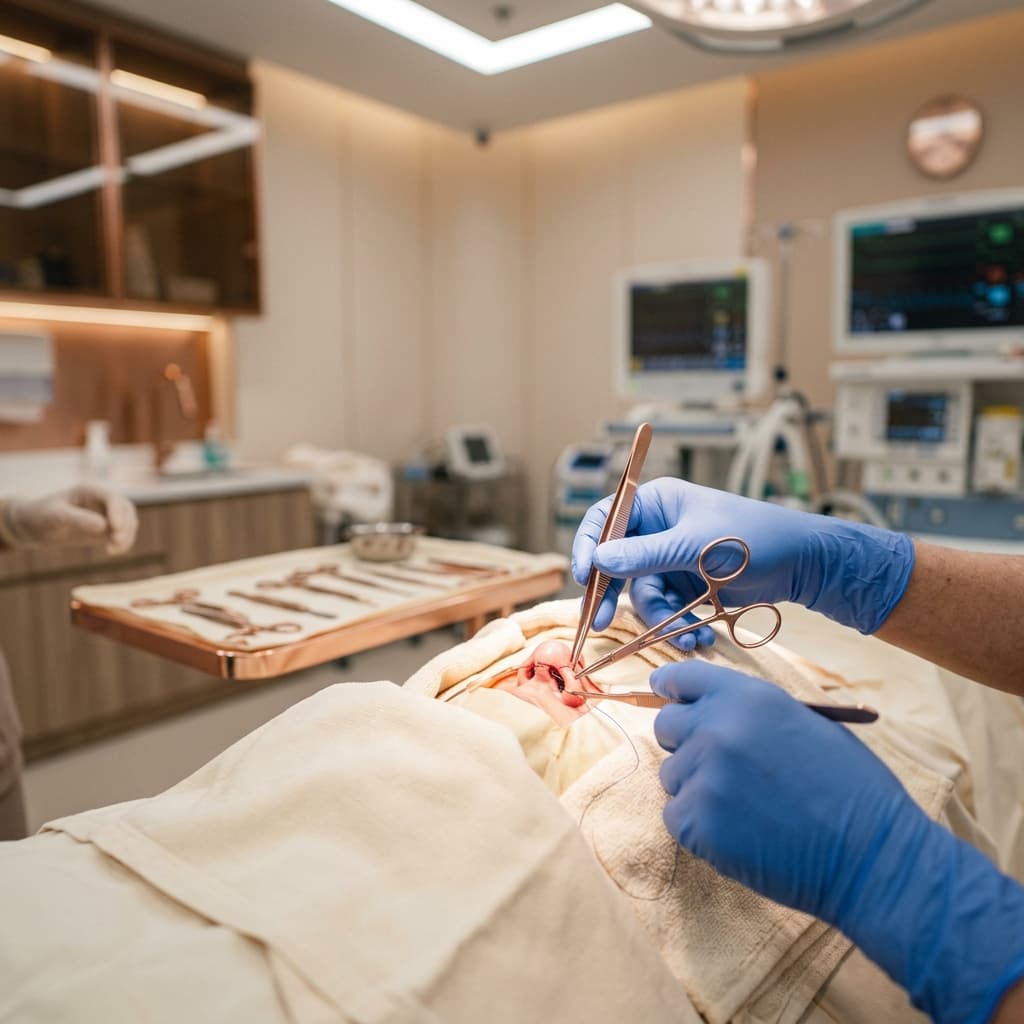
Light, Shadow and the Art of Body Sculpting
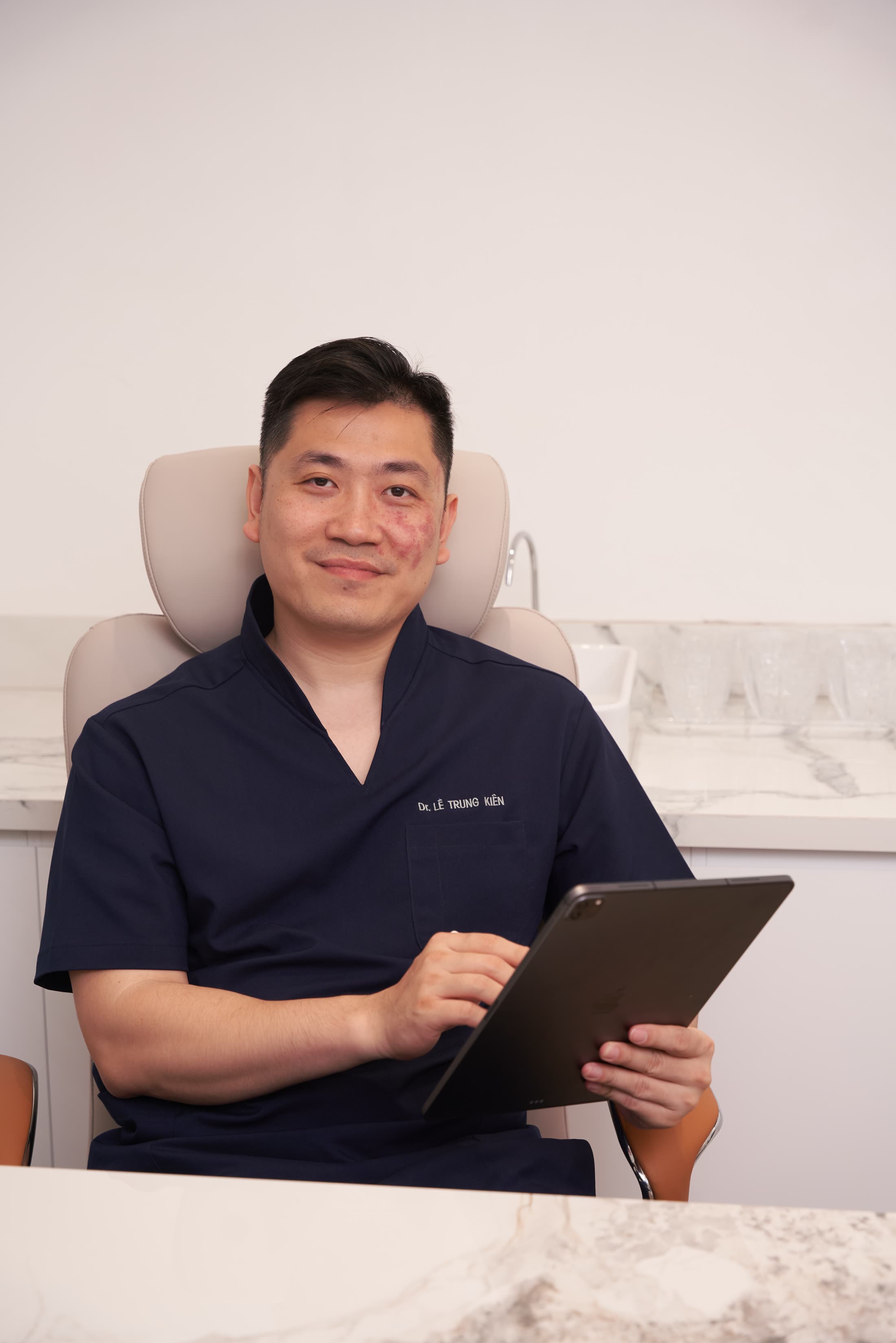
Author
Dr. Le Trung Kien
RASA Surgical Practice
"A surgical reflection on proportion, shadow and why body contouring is not only about removing fat, but about revealing form."
I still remember the afternoon I stood before the David statue in Florence. Not the first time I saw its image in a textbook, but the first time I stood before it in person, looking up. Michelangelo spent four years carving this statue from a massive block of marble that other artisans had previously deemed unusable. When asked how he created David from that block of stone, Michelangelo was said to have replied: "David was already in the stone. I simply removed what wasn't David."
I don't know if that's true, but I know it accurately describes what I do every day in the operating room.
Most people think plastic surgery is about creating something new. Adding, lifting, changing. But that's only half the story and not the most interesting part. At a deeper level, especially in high-definition body sculpting, a surgeon's work is not unlike that of a skilled sculptor: removing what conceals to reveal what's always been there.
And like all skilled sculptors, to do that, you must understand light.
Why plastic surgeons must learn from artists
There is an intriguing paradox in modern aesthetic surgery training: we teach surgeons how to hold a scalpel, how to manipulate a cannula, how to control depth, but few teach them how to see. More specifically: how to see like an artist.
A sculptor and painter learn from the outset that humans do not see what is truly there. We see the light reflected from a surface. Without light, there is no form. And how light interacts with a surface, creating areas of light and darkness, is what the human brain processes to understand depth, volume, and three-dimensional structure.
This is important in body contouring more than any other specialty, because the final result we create will be viewed in real-world lighting conditions. Not under the operating room lights, not in standard photographs, but under the light of a morning gym session, an afternoon at the beach, or standing in front of a mirror at 7 pm after a day's work.
The aesthetic outcome of surgery will be beautiful or not beautiful, regardless of what the surgeon removes or adds in the operating room. It depends on the surface that real-world light will reflect off of. And that is what the surgeon must envision before picking up a tool.
""A sculptor's color palette has only two colors: light and darkness. Every decision in the operating room is a decision about light."
The Realm of Light and Shadow: What Creates the Difference
Observe the abdomen of a competitive swimmer or a serious gym-goer. You'll notice the clear definition isn't due to their abdominal muscles being significantly larger, but rather the presence of dark areas between the muscle groups. These small depressions don't receive direct light, thus becoming shadows, and it's these shadows that make the surrounding muscle groups appear more prominent, with greater depth and realism.
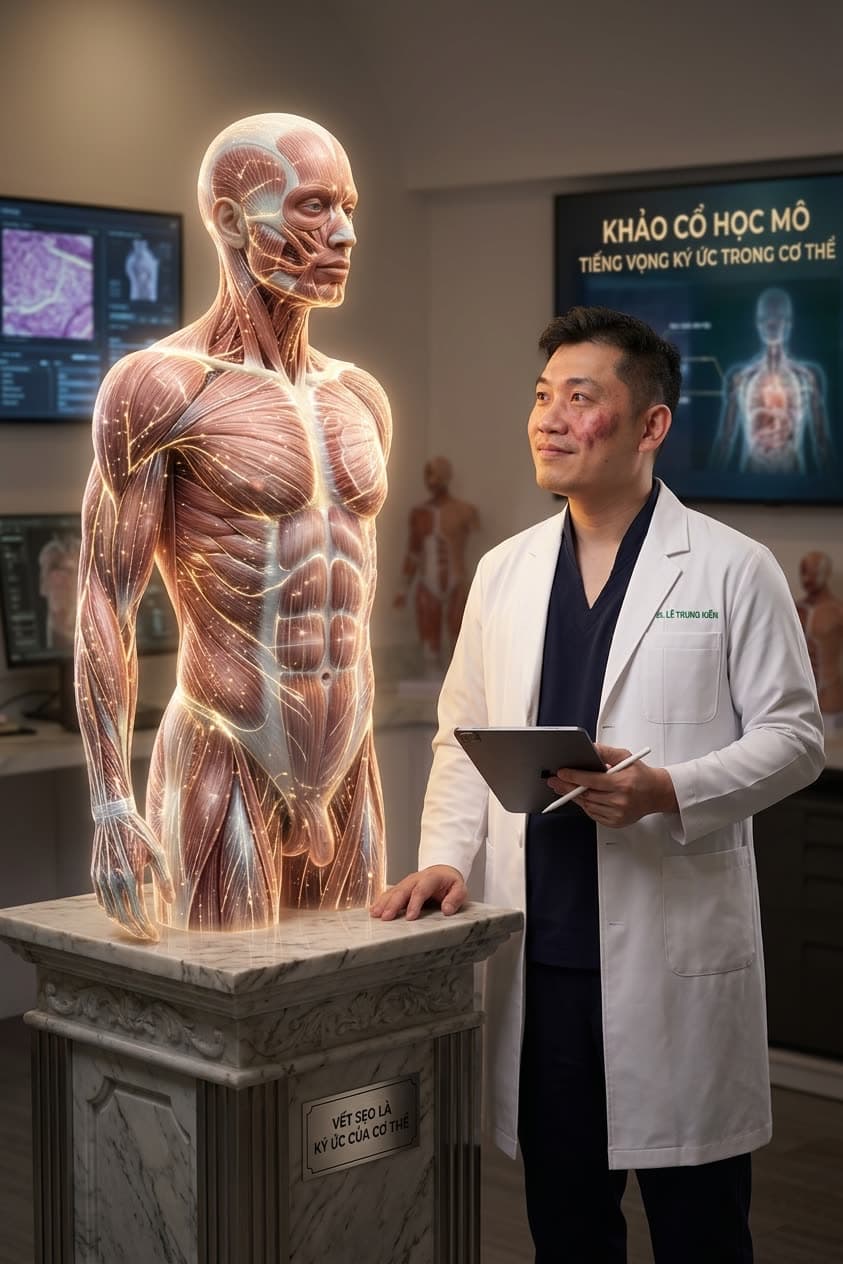
Điêu khắc cơ thể bắt đầu từ việc đọc ánh sáng và bóng tối
In advanced body sculpting techniques, we refer to these depressions as negative spaces, or the negative. And the protruding areas are positive spaces, or the positive. The entire art of advanced body shaping lies in designing the relationship between these two types of areas.
The positive areas receive more light, appear brighter, and protrude. The negative areas receive less light, appear darker, and are depressed. The human brain processes this contrast and perceives depth, volume, and muscle mass beneath the skin. This is the mechanism by which the human eye reads three-dimensional form from a two-dimensional surface.
When a doctor intentionally removes fat from these negative areas, they're not just removing fat; they're creating controlled shadows. And it's these shadows that make the surrounding muscles and structures appear more prominent, even if the muscles themselves haven't changed.
In contrast, when a doctor injects fat into the male area, selectively adding volume, they are creating convex surfaces that face the light. These two procedures, removing from the female area and adding to the male area, combined create what is called tonal progression: gradually transitioning from light to dark, naturally, without a sharp, artificial cut.
FEMALE AND MALE AREAS IN ADVANCED BODY SCULPTING
• Female areas (negative spaces): the grooves between the abdominal muscles, the lateral sides, the triangle below the sternum, and the longitudinal lumbar groove along the spine. Doctors carefully and superficially remove fat here to create shadows.
• Male areas (positive spaces): the surfaces of the muscle segments, shoulders, chest, and buttocks. Fat can be added to create convexity and reflect light.
• Transition zones: the thin strips connecting female and male areas, which are suctioned less, creating a natural tonal progression.
• The chief lines: from the hollow of the knee down to the navel along the alba, along the spine from top to bottom. These are the visual axes around which everything else is organized.
Taking away to reveal: Philosophy differs from traditional liposuction
This is the most basic difference between traditional liposuction and advanced body sculpting, and I want to speak directly about it because many patients do not understand the difference before consulting.
Traditional liposuction focuses on removing. The goal is to reduce the volume of fat in excess areas, making the patient look slimmer, smaller, and less protruding. This is a valuable and suitable intervention for many cases. However, it is not sculpting.
Advanced body sculpting focuses on revealing. The goal is not to make the patient smaller, but to make the existing structures under the skin, muscles, bones, tendons, visible and more beautiful through the way light interacts with the newly created surface.
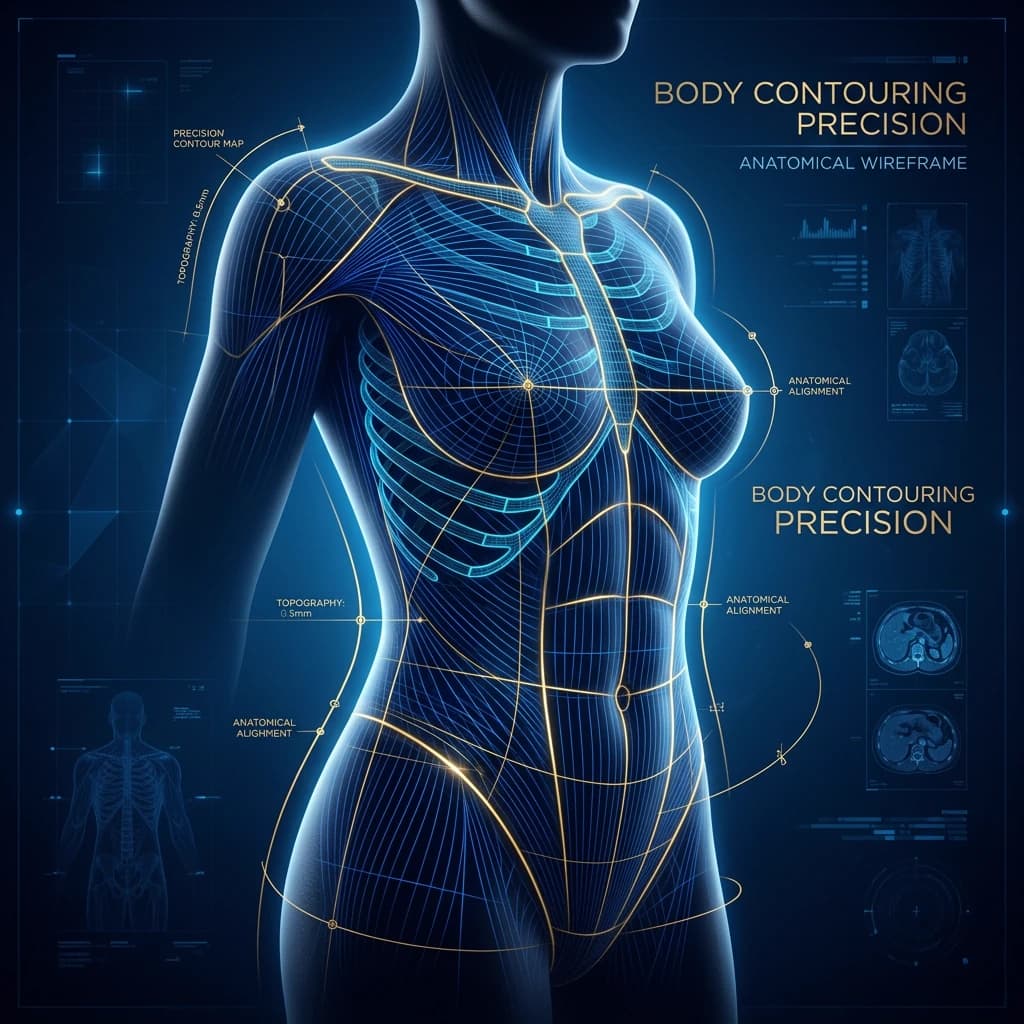
Tỷ lệ, đường cong và cấu trúc trong tạo hình cơ thể
This has a very specific practical consequence. In traditional liposuction, practitioners often want the surgeon to remove as much fat as possible. In body sculpting, it is sometimes correct to remove less fat in the male area and more in the female area, because contrast is more important than the total volume of fat removed.
A sculptor does not ask, "How much stone do I need to remove, " They ask, "What are the lines I need to create, and what do I need to remove to make those lines appear, " That is a completely different question.
Michelangelo when asked about David:
""Sculpture is simple. You just need to remove everything that is not the statue."
This is also the philosophy of advanced body sculpting.
Not created. Liberated.
There's a mistake I see in both inexperienced patients and doctors: thinking that the beauty of the human form is perfect symmetry and even lines.
Look at any athlete's body. The abdominal muscle groups on the left and right sides are never at the same height. The left side is slightly offset from the right. The lines created by the tendons are not symmetrical. The navel is not perfectly round and not exactly centered. Those small irregularities are not flaws. They are evidence of biological truth, and the human brain recognizes them as signs of reality, of nature.
Michelangelo understood this. David's hands are not perfectly symmetrical. The muscle lines are not machine-like. And that's why it looks lifelike, not like a plastic model.
In advanced body sculpture, one of the most difficult skills is knowing how to preserve the rule of irregularity. Preserving the small differences between the two sides, not trying to smooth everything out to be even, not creating lines that are too sharp and look like they were drawn with a ruler. What's called a "too perfect" result is actually a fake result, because it violates the visual language that the human brain has learned to recognize as truth.
This is particularly important when I sit with patients who bring in photos edited by AI or filters. Those images have perfect symmetry, sharp lines as if drawn, and a flat, wrinkle-free surface. They look good in the photo but do not exist on the human body as they do not reflect real light properly onto the surface.
""The best results look real. Not perfect. Because perfection does not exist in nature, and the human brain knows this even if we do not recognize it."
Light and the Main Line: The Framework of the Entire Work
Each sculpture has a main line, the one that the human eye follows first when looking at the overall work. With the human body, these lines are real and can be identified before surgery.
In front, the main line runs from the navel down along the linea alba, through the navel, and down to the pubic area. This is the visual axis along which all surrounding structures, the abdominal muscle compartments on both sides, the sides, the chest, are organized. At the back, the main line runs along the spine, forming a small groove between the two groups of back muscles (erector spinae). That groove, when viewed from behind, creates a sense of depth and clear structure.
The surgeon must begin with these primary lines before doing anything else. Primary lines define the framework. All subsequent work, creating the negative and positive areas, establishing the transition zones, is filling in that framework. If the surgeon starts with details before establishing the framework, the result will lack cohesion, looking like a collection of scattered correction points rather than a complete work of art.
This is why experienced surgeons in this field spend more time on pre-operative marking, standing and looking at the patient from various angles and lighting conditions before starting anything. Not because they are slow. But because the lines drawn on the skin before surgery are the design of the entire work.

Phẫu thuật như một thực hành giải phóng hình thể
WHAT DOCTORS SEE THAT PATIENTS DO NOT SEE
• Chief lines (đường chủ đạo): the visual axis that defines the overall framework, from which everything else must be harmonious
• Transition of tonal values: the dark area cannot be sharply separated from the light area; a smooth transition zone is necessary to look natural
• Natural asymmetry: the two sides of the body are never perfectly symmetrical; forcing perfect symmetry yields a false result.
• The behavior of light from different angles: the patient looks straight into the mirror, but others view them at 45°, 90°, and from behind. The result must be aesthetically pleasing from all angles.
• Volume in context: a bulge only has meaning when placed alongside a suitable concave area; a single volume does not create definition.
The Surgeon and the Artisan: Unspoken Commonalities
I do not wish to romanticize the profession in an untruthful manner. Cosmetic surgery is a medical specialty, with all the demands for safety, technique, and ethics that come with it. However, there is a part of this profession that we overlook if we do not acknowledge it.
A skilled sculptor is not only proficient in the technical aspects of carving stone. They possess the ability to envision the artwork within the raw material before commencing work. Their aesthetic language is shaped through years of observation, learning from the works of predecessors, and introspection on their own results. They know when to stop, as over-modeling (excessive shaping) yields results that appear artificial, no less than under-modeling.
This is entirely true for top-tier plastic surgeons. Technical proficiency is indispensable. However, it is the artistic eye, the ability to visualize three-dimensional results from two-dimensional surfaces pre-surgery, understanding the language of light and shadow, that distinguishes excellent outcomes from outstanding ones.
And, just as with any artistic skill, it is developed through mindful practice, serious observation, and continuous learning. The best surgeons I know all have the habit of viewing the human body as a sculptor views material: seeking out lines, determining volume, reading light. This habit does not form after a single course or technique. It is shaped over many years of paying attention to the right things.
""Technical skill gives you the ability to do. Artistic eye tells you what to do. And humility to understand the limitations of both is what protects your patients." - Dr. Lê Trung Kiên
This changes the way I counsel patients
When I view body contouring surgery as sculpting with light, I counsel patients differently than most doctors do.
I don't just ask patients what they want to remove. I ask them what they want to see. This is a significant difference. Wanting to remove belly fat is an answer about technique. Wanting to see the shape of one's abdominal muscles is an answer about aesthetic outcome. And only when I understand what patients want to see can I create a proper plan for creating the necessary balance between shadow and light.
I also take the time to explain to patients why the final result will look a certain way under different lighting conditions. Some results look their best under gym lighting (direct overhead lighting creates clear shadows), but are less impressive under the diffuse lighting of an office. This isn't a problem, it's the nature of body sculpting. But patients need to know this beforehand to avoid unrealistic expectations.
And I don't use AI-edited or filtered images to illustrate expected results, because those images describe a type of lighting and a type of surface that don't exist in reality. They may excite patients but will create expectations that no surgeon in the world can meet with actual surgery.
Conclusion: The Philosophy of Release
I write this article not to make plastic surgery sound more romantic than it is. It is still a medical field with all the demands for safety, technical skill, and medical ethics that must be prioritized above all.
But I write to share a perspective on the profession that I think is important, both for doctors and patients: at the highest level, body sculpting surgery is not about creating something new. It is a process of liberating what is already present, obscured by unnecessary fat or by volume imbalance.
A skilled sculptor does not impose their will on the material. They listen to the material, find the hidden form within, and remove what is preventing that form from appearing. Doctors do similar work with the human body, with an additional important demand: the material here is a person, and the best outcome is not just a visually pleasing result, but a result where the person can look in the mirror and recognize themselves in it.
This is something Michelangelo may have understood when he said David was already in the stone. The work of art is not something the artist creates. It is something the artist liberates.
""A good doctor does not create beauty. A good doctor removes what is obscuring the beauty that has always been there." - Dr. Lê Trung Kiên
Dr. CKII Le Trung Kien
Board-certified Plastic Surgeon with extensive experience in advanced body sculpting. This article draws inspiration from the research of Hoyos and Prendergast in high-definition body sculpting, combined with the author's clinical and philosophical perspectives.